Suisant7 / Wikimedia Commons, CC BY-SA 4.0 · CC BY-SA 4.0
Prague Attractions – A City You Cannot Take In From a Single Postcard
In photographs, Prague looks simple.
Charles Bridge. Above it, Prague Castle. Somewhere nearby, red roofs, a few towers and the Vltava, which cuts the whole picture neatly in half.
Then you arrive, and it turns out that the attractions of Prague do not line up along one tidy route.
Beyond Old Town Square begins Josefov. Beyond Charles Bridge, the Lesser Town (Malá Strana). Above it, Hradčany. Behind that, Strahov. A few stops further on lies Vyšehrad, on the other side of the city Žižkov, and just when you begin to understand the centre, you discover Letná, Holešovice, Vinohrady, the arcades of the New Town and dozens of places that were not on your first map.
And that is when the most common question comes up:
what should you see in Prague to take in a lot without spending the whole trip in a rush?
The simplest answer: do not explore Prague as a list of points.
Explore it in pieces.
Pair the square with Josefov. Charles Bridge with Kampa and the Lesser Town. Hradčany with Prague Castle. Leave Vyšehrad for a walk of its own. Treat the passages of the New Town as a separate world hidden behind shop windows and gateways.
The map starts to make sense.
And the city stops looking like a game board where you have to collect every point before the day is over.
If this is your first time in Prague and you would like to get the historic centre sorted in about two hours, a good place to start is our tour Prague in a Nutshell – Everything You Need to See.
Prague Attractions Map – Understand the City First
Before we get to the list of the most important places, it helps to look at Prague as several connected areas.
That is far more comfortable than planning individual monuments.
Old Town
Here you will find, among other things:
- Old Town Square (Staroměstské náměstí);
- the Orloj astronomical clock;
- the Church of Our Lady before Týn;
- Ungelt;
- the Klementinum;
- the Powder Tower (Prašná brána);
- the Municipal House (Obecní dům).
This is the most classic Prague.
Josefov
The former Jewish Quarter:
- synagogues;
- the Old Jewish Cemetery;
- Pařížská Street;
- traces of Franz Kafka;
- the stories of the Prague Golem.
New Town
Do not let the name fool you.
The New Town (Nové Město) was founded in the 14th century.
This is where you will find:
- Wenceslas Square (Václavské náměstí);
- the National Museum;
- the Lucerna Passage;
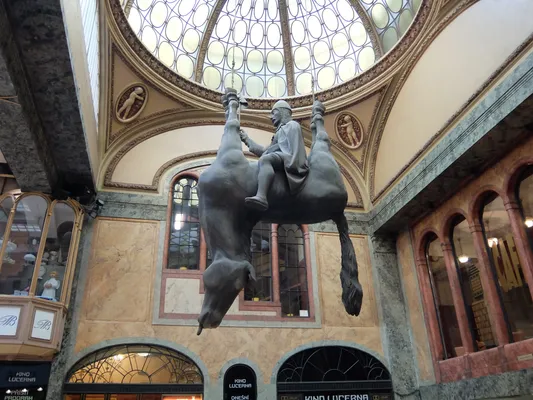
- David Černý's upside-down horse;
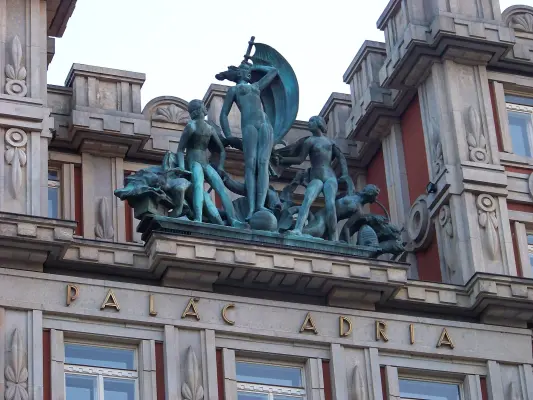
- the Světozor, Rokoko and Adria passages;
- the Dancing House;
- Charles Square (Karlovo náměstí).
Lesser Town and Kampa
On the other side of Charles Bridge:
- Baroque palaces;
- St. Nicholas Church;
- Nerudova Street;
- Kampa Island;
- the Lennon Wall;
- gardens;
- views of Charles Bridge.
Hradčany and Prague Castle
The most monumental part of the city:
- Prague Castle;
- St. Vitus Cathedral;
- the Old Royal Palace;
- St. George's Basilica;
- Golden Lane;
- the Loreto;
- Strahov;
- Nový Svět.
Prague Beyond the Strict Centre
This is where the city begins that is worth returning to on a second or third visit:
- Vyšehrad;
- Letná;
- Vinohrady;
- Žižkov;
- Holešovice;
- Karlín;
- Stromovka;
- Troja and the Prague Zoo.
The guide's notebook
>
The most common mistake in sightseeing Prague is combining attractions that look close on the map but are in reality separated by hills, cobblestones, queues and crowds. Plan by neighbourhoods, not by pins.
The Most Important Prague Attractions – Top Places for a First Trip
1. Old Town Square
If someone asks you to picture Prague without looking at photographs, you will probably still see Old Town Square.
The towers of the Týn Church. The townhouses. The Jan Hus Monument. The Town Hall. The Orloj. A crowd that starts to thicken under the clock a few minutes before the full hour.
The square is touristy.
Very touristy.
But that does not mean you can skip it.
This is where you can best see how, over the centuries, trade, religion, politics and everyday city life layered themselves onto one space.
It is worth coming in the morning, before the biggest groups arrive.
And then returning in the evening.
The same place can look like two different cities.
2. The Orloj, Prague's Astronomical Clock
Every hour, the crowd beneath the Old Town Hall raises its phones.
Small windows open.
The apostles appear.
The figures move.
A rooster crows.
And after a few dozen seconds, it is all over.
Someone always looks slightly disappointed.
The problem is that the Orloj is not interesting because the little figures move.
What is most fascinating is that this medieval clock shows several ways of measuring time, the motion of the Sun and the Moon, the signs of the zodiac and the vision of the cosmos held by a person who lived many centuries before the smartphone.
If you only watch the apostles, you are looking at the least interesting part of the whole mechanism.
3. Charles Bridge
Charles Bridge is like a very popular restaurant.
Everyone says it is crowded.
Everyone knows it is crowded.
And everyone goes anyway.
Rightly so.
The bridge is more than a crossing over the Vltava. It is one of the best places to understand the layout of the city.
On one side you see the towers of the Old Town.
On the other, the Lesser Town and Prague Castle.
At the sides, the river, Kampa, the embankments and more bridges.
It is best to arrive early in the morning.
At seven or eight o'clock the bridge is still a bridge.
At noon it starts to resemble a moving promenade.
4. Prague Castle
On the map it looks like a single monument.
In reality it is an entire complex.
There are courtyards, palaces, churches, gardens, lanes, administrative buildings and viewpoints.
You can walk through part of the complex without buying a ticket.
If you want to see the main historic interiors, set aside a few hours for them.
For a first walk around Hradčany and the outer parts of the Castle, you can choose Royal Prague – Hradčany and Prague Castle.
If you are interested in the interiors, the cathedral, the Old Royal Palace, St. George's Basilica and Golden Lane, the better choice is the tour Prague Castle – Interiors with a Polish-Speaking Guide.
5. St. Vitus Cathedral
The cathedral rises above the roofs of the Castle so high that it is hard to take in from up close.
It took almost six centuries to build.
Inside are royal tombs, the St. Wenceslas Chapel, a stained-glass window by Alfons Mucha, the tomb of St. John of Nepomuk and the entrance to the crypts.
You can look at this place as a church.
You can look at it as a museum.
You can look at it as one great story of how Czech rulers tried, over the centuries, to leave behind something more lasting than their own lives.
If you would like to go deeper into the history of the cathedral, read our guide: St. Vitus Cathedral in Prague – History, Interiors and Curiosities.
6. The Lesser Town
The Lesser Town looks just the way we imagine old Prague.
Narrow streets.
Palaces.
Baroque.
Steep roofs.
Churches.
Cobblestones.
Except that between the monuments people still live, trams still run, embassies still work and ordinary shops still trade.
It is best not to look for one attraction here.
Walk along Nerudova Street, step into Malostranské náměstí (Lesser Town Square), turn down the side lanes and make your way down towards Kampa.
7. Kampa
A few hundred metres from the busiest stretch of Charles Bridge, the city suddenly slows down.
Kampa has a park, the Čertovka canal, old mills, a museum, sculptures by David Černý and side streets where it is easy to forget Old Town Square.
It is also a good place for a break.
Prague does not demand a new attraction every fifteen minutes.
Sometimes a bench by the water is enough.
8. Josefov
The former Jewish Quarter is one of those places that should not be seen only from the outside.
The Pinkas Synagogue, the Old Jewish Cemetery, the Spanish Synagogue, the Klausen Synagogue and the Old-New Synagogue each tell a completely different chapter in the history of Prague's Jewish community.
It is also a space tied to Franz Kafka.
And, of course, to the legend of the Golem.
If you are drawn to the darker layer of the city, Josefov also appears in the evening on our route Prague in the Shadow of Legends.
9. Wenceslas Square
Wenceslas Square is a square in name only.
In practice it is a long city boulevard.
This is where demonstrations took place, political changes were announced, and people celebrated and protested.
At the top stands the National Museum.
Lower down stretch shops, restaurants, hotels and entrances to the passages.
It is a good place to see a Prague that is less "medieval" and more modern.
10. The Lucerna Passage and the Upside-Down Horse
A few steps from Wenceslas Square you can step under a roof and vanish from the street.
The Lucerna Passage is part of a large complex from the early 20th century.
Inside there is a cinema, the Great Hall, cafés and one of the most recognisable contemporary sculptures in the city.
Saint Wenceslas sits on a horse.
Except that the horse hangs upside down.
David Černý's sculpture is easy to treat as a funny photo stop, but in the Czech context it is hard not to see it as an ironic dialogue with the monumental statue of St. Wenceslas standing a few hundred metres away.
You will find more in the article Lucerna Palace and Lucerna Passage in Prague – Where to Find the Upside-Down Horse.
11. The Powder Tower and the Municipal House
These two buildings stand almost side by side, yet look as if they come from two different worlds.
The Powder Tower is dark, Gothic and monumental.
The Municipal House next to it is Art Nouveau, decorative and full of colour.
It is a great place to begin a walk through the historic centre.
From here Celetná Street leads straight to Old Town Square.
12. The Klementinum
The Klementinum occupies an enormous stretch of the Old Town.
It used to be a Jesuit college.
Today it is best known for its Baroque library and astronomical tower.
In season, tickets can disappear quickly, so it is worth planning your visit ahead.
If you do not intend to go inside, you will still walk along the complex on your way between the square and Charles Bridge.
13. The Dancing House
Two buildings that look as if they were in motion.
One leans towards the other.
Glass meets concrete.
The Prague we had been looking at for a while as a city of Gothic and Baroque suddenly shows the architecture of the late 20th century.
The Dancing House does not need a long visit.
It is worth walking down to the Vltava, though, and seeing it from the other side of the street as well.
14. Vyšehrad
Vyšehrad is one of the most underrated major attractions in Prague.
Its name turns up very often in search data, and no wonder.
It is a former fortress set high above the Vltava, with a park, the Basilica of St. Peter and St. Paul, a cemetery of distinguished Czechs and some of the best panoramas in the city.
It does not have the rhythm of Prague Castle.
There is more space.
More locals.
Fewer tour groups.
More time to simply wander without a goal.
You will find a separate guide here: Vyšehrad – Legend, History and a Panorama of Prague.
15. Petřín
Petřín is the green hill above the Lesser Town.
You can walk up, or – when it is running – take the funicular, bearing in mind that it is worth checking its operation and the rules of travel before your visit.
On the hill you will find:
- a lookout tower;
- a mirror maze;
- gardens;
- walking paths;
- views of the city.
Petřín works well on a longer stay and with children.
Do not try to add it to a full visit to Prague Castle on the same day, though, if you do not enjoy running up and down hills.
16. Letná
From Letná, Prague looks entirely different.
We are not looking at a single monument.
We are looking at the layout of the city.
Bridge after bridge crosses the Vltava.
Behind them appear the towers of the Old Town.
It is one of the best free viewpoints in Prague.
Especially in the evening.
17. The Metronome
On Letná stands a huge metronome.
On the spot where a monumental statue of Stalin once stood.
You can see the object itself quickly.
The story of the place is far more interesting.
The 20th century left marks in Prague that do not always look like classic monuments.
18. Žižkov and the Television Tower
The Žižkov Television Tower rises above the townhouses like an object from another city.
David Černý's giant babies crawl up its structure.
Some find the tower fascinating.
Others find it exceptionally ugly.
And that is exactly why it is worth seeing.
Žižkov is, incidentally, a good place for an evening outside the historic centre.
19. Vinohrady
If after two days you are starting to tire of fridge-magnet shops, head to Vinohrady.
Wide streets.
Art Nouveau townhouses.
Cafés.
Parks.
Local restaurants.
This is not a district of one great attraction.
It is a place that shows what Prague looks like when it is not trying to impress tourists.
20. Riegrovy sady
The park in Vinohrady is known, among other things, for its view of Prague Castle.
In the evening the grass fills with people.
Someone brings a blanket.
Someone, a beer.
Someone watches the sunset.
It is one of those attractions you do not have to pay for, book a time slot for or stand in a queue for.
21. Holešovice
This former industrial part of the city is changing fast.
There are galleries, halls, a market, new restaurants and cultural spaces.
Holešovice is a good answer for people who ask:
what should I see in Prague if I already know the classic sights?
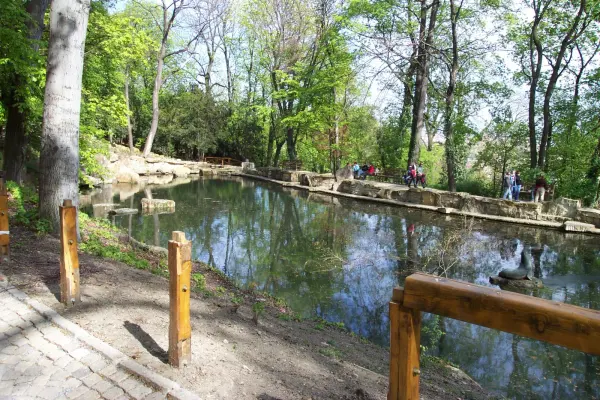
22. Stromovka
A huge park not far from Holešovice.
Paths, ponds, lawns and plenty of space.
A good place to rest on a family trip or after an intense day of sightseeing.
23. The Prague Zoo
The Prague Zoo is not an attraction for "a quick visit".
If you are heading to Troja, it is best to give it a large part of the day.
The grounds are extensive and hilly.
For families with children it is one of the surest bets in the city.
If you are planning a family trip, see also our guide Prague with Children – Attractions and a Ready-Made Family Sightseeing Plan.
24. Troja
Next to the zoo stands the Baroque Troja Palace and its garden.
It is a good combination for those who want to pair a family day with architecture and a quieter part of the city.
25. The Náplavka Embankment
Prague does not end at its monuments.
Náplavka is a stretch of embankment where locals stroll, sit by the water, visit bars set in former riverside vaults and come for events.
It is best to drop in here in good weather.
26. A Cruise on the Vltava
After several hours of walking, a cruise has one remarkable advantage.
You can look at the city sitting down.
From river level, Charles Bridge, Kampa, Hradčany and the embankments look different.
It is best to treat a cruise as a rest after sightseeing, not as another task to complete.
27. The Wallenstein Garden
Right next to the bustling Lesser Town lies the Senate garden.
Baroque geometry, peacocks, fountains and an enormous artificial wall that resembles a grotto.
In season it is worth checking the current opening hours.
28. Nový Svět
A few minutes from the main square of Hradčany you can find lanes that look more like a small town than the centre of a European capital.
Nový Svět is short.
And that is exactly why you should not try to turn it into a great attraction.
Walk through slowly.
Look at the houses.
Listen to the silence.
That is enough.
29. Strahov
Strahov Monastery draws visitors above all for its historic library.
But it is also worth coming for the panorama of the city and for a walk towards Hradčany.
Strahov combines well with the Loreto, Nový Svět and Prague Castle.
30. Prague at Night
After dark, familiar places change character.
The square empties.
The stone of Charles Bridge grows darker.
The courtyards and alleys of the Old Town begin to look exactly the way places should look about which legends have been told for hundreds of years.
If you like that atmosphere, you can choose Prague in the Shadow of Legends – Ghosts, Apparitions and Extraordinary Tales.
What to See in Prague in 1 Day?
If you have only one day, do not try to see the whole city.
The best compact route looks roughly like this:
Powder Tower → Old Town Square → Josefov from the outside → Charles Bridge → Kampa → Lesser Town
If you still have energy, you can take a tram up to the viewpoint by the Castle.
You will find a detailed plan in our separate guide to Prague in one day.
What to See in Prague in 2 Days?
On the first day, focus on the right bank:
- New Town;
- Old Town;
- Josefov;
- Charles Bridge.
On the second day, move to the left bank:
- Strahov;
- Hradčany;
- Prague Castle;
- Lesser Town;
- Kampa.
We have described the full route step by step here: What to See in Prague in 2 Days?.
What to See in Prague in 3 Days?
The third day lets you step away from the postcard centre.
Choose one of two directions.
A Calmer Variant
Vyšehrad → embankment → Vinohrady → Žižkov
A More Contemporary Variant
Letná → Holešovice → Stromovka → the Vltava
You will find a ready plan in the article What to See in Prague in 3 Days?.
Prague – Free Attractions
In Prague you can see a great deal without buying tickets.
Free to enjoy are, among others:
- Old Town Square;
- Charles Bridge;
- most streets of the Old Town;
- Kampa;
- the Lesser Town;
- many parts of Hradčany;
- the courtyards of Prague Castle;
- Letná;
- Riegrovy sady;
- Vyšehrad in its park and fortification areas;
- the embankments;
- the passages of the New Town;
- Nový Svět;
- many viewpoints.
The costliest mistake a tourist makes is not failing to buy a ticket.
It is buying five tickets to places they no longer have the strength to see.
Unusual Attractions in Prague
If the classic monuments are not enough, look for:
- the upside-down horse in Lucerna;
- the babies on the Žižkov tower;
- the head of Franz Kafka;
- sculptures by David Černý;
- the passages of the New Town;
- Cubist townhouses;
- Brutalist architecture;
- the Folimanka shelter;
- old courtyards;
- lesser-known viewpoints;
- the districts of Karlín and Holešovice.
Prague is most interesting precisely when smaller things begin to appear between the great attractions.
Prague with Children – Which Attractions to Choose?
With children, limit the number of monuments.
These work well:
- the zoo;
- Petřín;
- the mirror maze;
- a short cruise;
- Kampa;
- playgrounds;
- the National Technical Museum;
- Království železnic (Kingdom of Railways);
- trams;
- parks.
Instead of four monuments, choose two.
Instead of one more museum, take an hour's break.
Prague with children is very good, as long as you do not try to explore it the same way you would on a weekend for two.
You will find more suggestions here: Prague with Children – 21 Attractions and a Family Sightseeing Plan.
Prague in the Rain
Rain does not mean a lost day.
You can combine:
- the passages of the New Town;
- the National Museum;
- the National Technical Museum;
- the synagogues of Josefov;
- the interiors of Prague Castle;
- galleries;
- cafés;
- the Klementinum;
- a covered cruise.
Wet cobblestones can be slippery.
Especially on the steep streets of the Lesser Town and Hradčany.
How to Get Around Between Prague Attractions?
The best combination is:
on foot + tram + metro.
Use the metro for longer journeys.
The tram for going up to Hradčany and for getting to Vinohrady, Žižkov, Letná or Holešovice.
Explore the centre on foot.
It is always worth checking the current travel rules, tickets and fares before your trip in the PID system.
You will also find practical information in our guide Prague Practical Guide 2026/2027.
Which Prague Attraction Should You Not Skip?
It depends on your interests.
If it is your first time in the city:
Charles Bridge, Old Town Square and Prague Castle.
If you are interested in history:
Josefov, Prague Castle and Vyšehrad.
If architecture:
Old Town, New Town, Lucerna, Cubism and the Dancing House.
If panoramas:
Letná, Vyšehrad, Petřín and Hradčany.
If you want to feel the everyday city:
Vinohrady, Žižkov, Karlín or Holešovice.
If you are with children:
the zoo, Petřín, Kampa and a cruise.
There is no single list of the best attractions for everyone.
And thank goodness for that.
The Most Common Mistakes When Sightseeing in Prague
Trying to See Everything
Prague is compact only on the map.
After eight hours on cobblestones it stops being compact.
Going Into Everywhere
Not every interior is a must.
Choose the ones that really interest you.
A Car in the Centre
It most often makes sightseeing harder instead of easier.
Charles Bridge Only at Noon
Come back in the morning or in the evening.
The difference is enormous.
Prague Castle From Below
If you can, take the tram up to Hradčany and explore on your way down towards the Lesser Town.
Your knees will thank you.
A Plan Without Breaks
A coffee, a park or a cruise is not wasted time.
It is part of the journey.
Is It Worth Exploring Prague With a Guide?
A first walk with a guide has one big advantage.
It puts the city in order.
After two hours it is easier to understand where the Old Town ends, why Josefov looks different, where the Royal Route ran and why buildings separated by hundreds of years of history stand side by side on a single square.
Afterwards you can explore on your own.
If it is your first time, see Prague in a Nutshell.
For Hradčany we recommend Royal Prague.
For the Castle interiors: Prague Castle – Interiors with a Polish-Speaking Guide.
For the evening: Prague in the Shadow of Legends.
You will find all the routes here: Prague tours with a Polish-speaking guide.
Prague Attractions – FAQ
What Are the Most Important Attractions in Prague?
For a first trip, it is worth seeing Old Town Square, the Orloj, Charles Bridge, Prague Castle, St. Vitus Cathedral, the Lesser Town, Kampa and Josefov.
On a longer stay, add Vyšehrad, Letná, Vinohrady, Žižkov or Holešovice.
What Can You See in Prague for Free?
Charles Bridge, Old Town Square, Kampa, a large part of Hradčany, the courtyards of Prague Castle, Letná, parks, embankments, the passages of the New Town and many viewpoints.
How Many Days Do You Need to Explore Prague?
Two days are enough for the most important places.
Three days let you slow down and see the districts off the main route too.
Four days give you the chance to explore museums, Josefov, Vyšehrad and the less obvious parts of the city at a relaxed pace.
Is Prague Big?
The historic centre is relatively compact, but the attractions lie at different elevations.
Cobblestones, hills and queues make distances feel different from how they look on the map.
Where Is the Best View of Prague?
The best-known panoramas can be seen from Letná, Hradčany, Petřín and Vyšehrad.
Each of these points shows the city from a different side.
What to See in Prague in the Evening?
Charles Bridge, Old Town Square, the embankments, Kampa and the alleys of the Old Town.
An evening walk in the footsteps of Prague's legends is a good idea too.
Is Vyšehrad Worth Visiting?
Yes.
Especially if you are in Prague for more than two days or want a rest from the biggest crowds in the centre.
Is the Prague Visitor Pass Worth Buying?
It depends on the number of paid attractions you actually plan to visit.
Before buying, add up the prices of the chosen entries separately and compare them with the current price of the card.
Do not buy it just because it "might come in handy".
Where Can You Find a Map of Prague Attractions?
The most convenient way is to create your own map divided into areas: Old Town and Josefov, New Town, Hradčany and the Castle, Lesser Town and Kampa, and places outside the centre.
Such a division is more practical than a map with several dozen random pins.
In Closing
You can come to Prague with a list of thirty attractions.
You can even mark them all on a map.
But a city is not remembered as a collection of points.
It is remembered as the moment when, in the morning, Charles Bridge was almost empty.
The smell of wet cobblestones after rain.
A tram climbing up to Hradčany.
The view from Vyšehrad.
The upside-down horse hanging beneath the ceiling of Lucerna.
Peacocks strolling through a garden.
An evening by the Vltava, when suddenly there is nowhere left to go.
The best map of Prague attractions should therefore also have a little empty space on it.
Because that is very often where happens what we later remember best.
Sources and Useful Websites
When planning your sightseeing, it is worth checking current information directly in the official sources: