Most first-time visitors to Prague head straight for Charles Bridge (Karlův most), the Old Town Square (Staroměstské náměstí), and Prague Castle (Pražský hrad). However, there is one more place that definitely deserves a spot on your itinerary: Vyšehrad.
It is one of our favorite parts of Prague for a quieter stroll. Here you will find the walls of the old fortress, a park, beautiful views of the Vltava, a monumental basilica, and one of the most important cemeteries in the Czech Republic.
And yet, it is usually significantly calmer here than in the tourist center itself.
Vyšehrad or Vyšehrad?
Both names refer to the same place.
In Czech, it is spelled Vyšehrad, while in Polish you will often encounter the name Wyszehrad.
So, if you search Google for:
- Vyšehrad,
- Vyšehrad Prague,
- Vysehrad Prague,
- Vyšehrad,
you will end up at exactly the same location.
Is it worth visiting Vyšehrad in Prague?
Yes, especially if you have more than one day in Prague.
Vyšehrad is a great complement to the classic city tour. It certainly doesn’t replace Charles Bridge, the Old Town, or Prague Castle, but it shows a completely different face of Prague.
This is the place to slow down.
Stroll along the walls, sit for a moment in the park, and look at the city from above.
A major advantage is that walking around the external area of the complex is free. Tickets are only required for selected sites.
What to see at Vyšehrad?
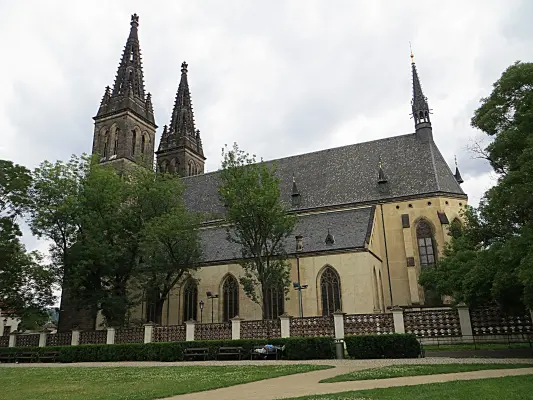
1. Basilica of Saints Peter and Paul
This is undoubtedly the most distinctive building at Vyšehrad.
The two high towers of the basilica are visible from many places along the Vltava. The current appearance of the temple is largely the result of a Neo-Gothic reconstruction, and the interior is richly decorated.
If you have time, it is worth stepping inside.
Entry to the basilica is paid, and opening hours may vary depending on the season and services being held.
2. Vyšehrad Cemetery and Slavín
Right next to the basilica is the Vyšehradský hřbitov, or Vyšehrad Cemetery.
For Czechs, this is a place of immense significance.
Over 600 prominent figures of Czech culture, science, and art rest here. You will find the graves of composers, writers, actors, and scientists, among others.
The most distinctive part of the cemetery is the monumental mausoleum Slavín.
Even if you usually don’t visit cemeteries while touring a city, this is an exception worth making.
3. Rotunda of St. Martin
The small Rotunda of St. Martin is one of the oldest surviving monuments at Vyšehrad.
It is easy to overlook because, compared to the massive basilica, it looks very modest.
However, it is worth getting closer—especially if you are interested in Prague’s history.
4. Vyšehrad Walls and Views of the Vltava
For us, this is one of the main reasons to visit.
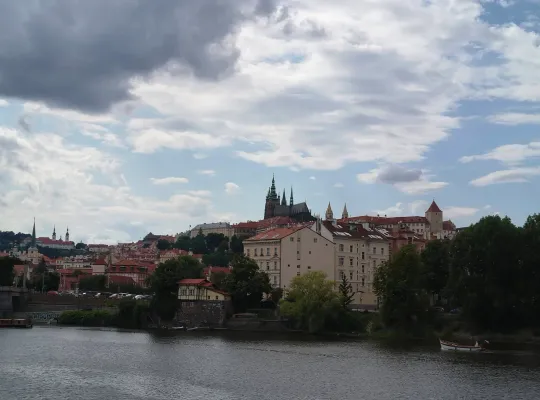
The Vyšehrad walls offer excellent views of the Vltava, the bridges, and the southern part of Prague.
It is also a very good spot for photography.
If you catch it on a nice day, don’t rush. Vyšehrad is best explored by wandering aimlessly from one viewpoint to another.
5. Vyšehrad Casemates
Beneath the fortifications lie the casemates, a system of underground corridors connected to the old fortress defenses.
The total length of the casemate system exceeds one kilometer.
This is an attraction particularly interesting for those who enjoy fortifications, underground passages, and less obvious places.
6. Vyšehrad Park
Vyšehrad is not just about historical monuments.
A large part of the complex consists of green spaces, making it an excellent place to relax.
In summer, you can sit in the shade of the trees, take a break during your tour, or simply spend a quiet afternoon away from the largest crowds in the center.
How much time do you need to visit Vyšehrad?
For a leisurely stroll alone, plan about 1.5–2 hours.
If you want to enter the basilica, see the cemetery, visit the casemates, and stop at viewpoints, you can comfortably spend 2–3 hours here.
We do not recommend rushing through Vyšehrad.
This place is best enjoyed when you don’t have to check your watch every few minutes.
How to get to Vyšehrad?
The easiest way is to use public transport.
One option is to take Metro Line C and get off at Vyšehrad station. You can also reach the area by tram from the riverbank side, and then walk up the hill. The official website of the complex indicates both the metro and trams as convenient ways to get there.
If you are driving by car, remember that the Vyšehrad grounds themselves are primarily a pedestrian zone.
Therefore, just like with most attractions in central Prague, it is not worth wasting time looking for parking.
The metro, tram, or Bolt/taxi will usually be much more convenient.
Vyšehrad and a stroll along the Vltava
A good idea is to combine Vyšehrad with a walk along the Vltava.
You can first visit the hill, then head down toward the river and walk along the embankment toward the center.
This is a great way to see a more local side of Prague and gradually make your way to the most famous attractions.
Vyšehrad or Prague Castle?
If you are in Prague for the first time and must choose only one place, we would choose Prague Castle and Hradčany.
Treat Vyšehrad as a perfect complement.
Prague Castle is monumental and full of the most important historical sites.
Vyšehrad is quieter, more walkable, and definitely less overwhelming in terms of tourist numbers.
It is best to see both places.
Choose a route for one hour, two hours or half a day
About an hour: stay on the surface of the hill
For a short visit, limit the programme to part of the fortifications, the basilica surroundings and one viewpoint. Do not buy admission to a guided interior visit that conflicts with your return. The walk from the metro and back also takes time.
This is an introductory option, not enough to inspect every building or walk the entire circuit of walls. If mist hides the panorama, take a shorter walk and return in better visibility.
Two hours: combine history with a pause
See the gates, rotunda, basilica surroundings and cemetery, then a chosen stretch of river views. At the graves, do not try to find every famous name. One or two people whose work you know can give a better sense of the place.
If entering the basilica, shorten the later walk. If the casemates are your priority, arrange the rest around their current visiting times. Two hours does not guarantee every interior; it is a useful starting point for a personal programme.
Half a day: stay in this part of Prague
After an unhurried hilltop visit, descend towards Podskalí and the Vltava if the chosen route suits your group. Local architecture and lunch can naturally extend the outing. There is no need to travel straight to Petřín or Letná for another panorama.
This gives more than a brief stop between the castle and departure. Vyšehrad rewards time to sit and watch the river without comparing every minute with a timetable.
Free spaces and separately planned interiors
The walking grounds and paid sites are two different layers of the visit. Explore the fortifications and basilica surroundings without buying every available admission. For a particular interior, check its rules, price and start time instead of assuming one common ticket covers everything.
This matters especially underground. Do not treat the casemates as a passage you can enter at any moment halfway through a walk. The official Vyšehrad website publishes current routes, access and programmes.
Pushchairs and avoiding stairs
The choice of approach is most important. You can arrange an easier walk on the hill itself, but riverside approaches include climbs and, on some routes, stairs. Do not choose the return only because it looks shorter on a screen than the approach from the metro.
Check surfaces and the energy you will have left at the end. For a private walk, mention the need to limit stairs beforehand. The order and finish can then be adjusted. Not everyone needs to complete the whole fortification circuit to enjoy the principal views.
The cemetery and the panorama need different rhythms
Conversation and photography feel natural beside the walls. In the cemetery, slow down, remain quiet and leave space for other visitors. It remains a place of remembrance even when included in a sightseeing route.
Distinguish the legend of Prague's beginnings from documented stages of the hill's history. Libuše's prophecy belongs to Czech culture, rather than a literal record of the city's foundation. Read Vyšehrad's history and legends.
Arriving and linking the hill with the river
Metro C to Vyšehrad is a straightforward option, but the historic grounds are not immediately beside the platform. Check the station exit and walking route towards Tábor Gate. From the riverside, tram stops such as Výtoň or Palackého náměstí leave an uphill walk; choose the path carefully if avoiding steps.
Parking near the pedestrian grounds is limited. If driving to Prague, read the parking guide rather than assuming you can park by a gate.
A descent towards the Vltava can include Josef Chochol's Cubist houses around Rašínovo nábřeží. Leave time for a meal rather than immediately adding a second hill. For a larger programme, see the one-, two-, three- and four-day plans.
Touring Prague with a Polish Guide
If, besides Vyšehrad, you want to learn more about the key histories, monuments, and curiosities of Prague, you can also choose to go on a tour of Prague with a Polish guide.
Current tours can be found at .
This way, instead of just passing by row houses, churches, and palaces, you will learn what actually happened in these places and why they are important to Czechs.
Vyšehrad – Practical Tips
Finally, a few things to keep in mind:
- entry to the Vyšehrad grounds is free,
- tickets are valid for selected sites,
- wear comfortable shoes – there will be some walking,
- it is worth coming here on good weather,
- plan at least 1.5–2 hours for a stroll,
- there is no point driving to the attraction itself,
- it is best to use the metro, tram, or taxi/Bolt,
- if you like photography, make sure to approach the walls from the Vltava side.
Is Vyšehrad worth visiting? Our opinion
Definitely yes.
Especially if you have already seen the main attractions of Prague or are spending a few days in the city.
Vyšehrad offers something that is often missing in the strict center: space, greenery, beautiful views, and a bit of peace.
Don’t just check off the basilica and head straight back to the metro.
Walk along the walls, visit the cemetery, stop at a viewpoint, and give yourself a moment to simply look at Prague from above.
That is when Vyšehrad makes the biggest impression.