ŠJů (cs:ŠJů) / Wikimedia Commons, CC BY-SA 3.0 · CC BY-SA 3.0
Adria Palace in Prague – An Insurance Company, a Stone Fortress and the Most Czech of Architectural Experiments
There are buildings in Prague that must be seen from afar.
St. Vitus Cathedral needs a courtyard. The National Theatre is best admired from the other bank of the Vltava. The towers of the Týn Church rise above the roofs of the Old Town.
Adria Palace works the other way round.
First you have to come close.
Stand on the corner of Národní and Jungmannova. Lift your head. And for a moment try to work out what exactly you are looking at.
A palace?
A fortress?
A bank?
A Renaissance castle built by someone who knew Cubism?
On the façade there are stone arches, geometric divisions, heavy cornices, little towers and sculptures. Everything is monumental, a touch exaggerated and very self-assured.
This is Palác Adria – one of the most characteristic examples of rondocubism in Prague.
A style that could really only have been born here.
If you like places that most tourists stumble upon by accident, Adria is also one of the stops on our tour Hidden Prague – Passages, Architecture and City Stories. We walk through urban shortcuts and passages that show a completely different Prague from the one on the postcards.
Where Is Adria Palace?
Adria Palace in Prague stands at Jungmannova 31, on the corner of Jungmannova and Národní třída.
It is literally a few minutes' walk from:
- Wenceslas Square,
- the National Theatre,
- the Franciscan Garden,
- the Světozor passage,
- the Lucerna passage,
- David Černý's moving Head of Franz Kafka.
The Adria Passage runs through the building, allowing you to cross between Jungmannova and Národní.
And that is exactly why it is easy to see, even if you had no plans to look at architecture at all.
In Prague, passages often begin innocently.
A door. A corridor. A shop. A staircase.
And then it turns out we have walked into an entirely different city.
First There Was Another Palace Here
Today's Adria is not the first stately building on this spot.
In the 19th century an older palatial residence connected with the Thun family stood here. At the beginning of the 20th century the property was bought by the Italian insurance company Riunione Adriatica di Sicurtà.
The name is long.
Long enough that even on a monumental façade it would look a little awkward.
The company had its headquarters in Trieste and operated in many parts of the Austro-Hungarian monarchy. After the creation of Czechoslovakia it still needed a prestigious seat in Prague.
It did not want an ordinary office block.
It wanted a building that would say: we are serious, we are wealthy, and we are here to stay.
Insurers have always loved solidity.
In this case solidity took the form of a stone fortress in the middle of the city.
Josef Zasche and Pavel Janák – Two Architects, One Very Strange Palace
The design took shape in the first half of the 1920s.
Two architects are chiefly associated with the building: Josef Zasche and Pavel Janák.
Zasche was responsible for the basic concept of the building. Janák played an enormous role in shaping the look of its façade.
And this is where it gets most interesting.
Because they could have built a modern office block.
Europe was just entering modernism. Architects were simplifying façades, rejecting ornament and starting to proclaim that form should follow function.
Adria did almost the opposite.
Behind the modern structure, a façade was hidden that looks as if someone were trying to tell the story of a new state in stone, semicircles, towers and sculpture.
Rondocubism – What Exactly Is It?
If you hear the word rondocubism while walking around Prague, you might get the impression that architectural historians invented it specifically to scare tourists away.
In reality the matter is more interesting.
Before the First World War, Czech Cubism used sharp angles, crystalline forms and geometric folds.
After 1918 a new state came into being – Czechoslovakia.
Architects began to look for a style that would be modern but at the same time their own.
So the sharp Cubist forms were joined by:
circles, semicircles, arches, cylinders and rounded shapes.
Hence the "rondo".
Rondocubism is also sometimes called the national style or arched Cubism.
It did not last long.
That is precisely why it is so interesting today.
It was like a brief moment between two eras: the world still wanted decoration and symbols, but modernity was already standing at the door.
Adria Palace is one of the best places to see that moment in stone.
A Building That Pretends to Be an Italian Palace and a Czech Fortress at Once
Just look at the highest parts of the building.
Towers appear, and something resembling battlements.
The whole has a touch of the Italian city palazzo, but filtered through the Central European imagination of the early 20th century.
That is no accident.
The investor, after all, was a company with roots on the Adriatic.
At the same time, the building was going up when the young Czechoslovakia was searching intensely for its own visual language.
The effect is strange.
A bit of Italy.
A bit of Bohemia.
A bit of Renaissance.
A bit of Cubism.
And a lot of stone.
In architecture, such mixtures often age badly.
Adria was lucky.
After a hundred years it looks even more remarkable than on the day it was completed.
Look at the Façade First. Only Then Go Inside
At Adria it is worth doing something we usually do not do in the city centre.
Stop.
Do not start photographing right away.
Look first.
The façade is designed like a grand stage set. Lines draw the eye ever higher. Heavy architectural elements are interwoven with sculptural decoration.
Very important artists of the era worked on the decoration of the palace, among them Otto Gutfreund, Jan Štursa, Karel Dvořák and Bohumil Kafka.
In Prague, the surname Kafka automatically sets off a single thought.
No, not that Kafka.
Bohumil Kafka was an outstanding Czech sculptor. He created, among other works, the monumental statue of Jan Žižka that stands today on Vítkov.
Prague likes such traps.
A Ship Sails on the Top
One of the most characteristic elements of Adria's decoration is a sculptural group connected with navigation and the sea.
It makes sense.
The company's name referred to the Adriatic, and its headquarters were in Trieste, a port city.
So the sea ended up on the façade of a building standing in a country that has no sea.
It is a very Central European situation.
Czechs can discuss Croatia for half a day with such commitment that you would think the Adriatic began just beyond Brno.
A hundred years ago an insurer simply put it on the roof.
The Adria Passage – When the Street Walks Into the Building
After looking at the façade you can step into the Adria Passage.
And suddenly the monumental palace becomes something everyday.
People cut through on the way elsewhere.
Someone is heading to the theatre.
Someone, for a coffee.
Someone does not even look at the architecture.
That is one of the most interesting qualities of Prague's passages.
They are not decoration.
They work.
They connect streets, shorten the way and let everyday life pass through the middle of a building.
If after Adria you walk on towards the Franciscan Garden, Světozor and Lucerna, you can cross a good part of the centre through a system of passageways, courtyards and galleries.
It is a Prague that exists in parallel with the one on the pavements.
Adria and Lucerna – Worth Seeing Together
If you have half an hour, combine Adria Palace with Lucerna Palace.
A few minutes' walk separates them, and they show two different ways of thinking about the modern city.
Lucerna is earlier, more Art Nouveau-meets-modernist, and is associated with cinema, entertainment and the Havel family.
Adria is heavier.
More monumental.
And more consciously "national" in form.
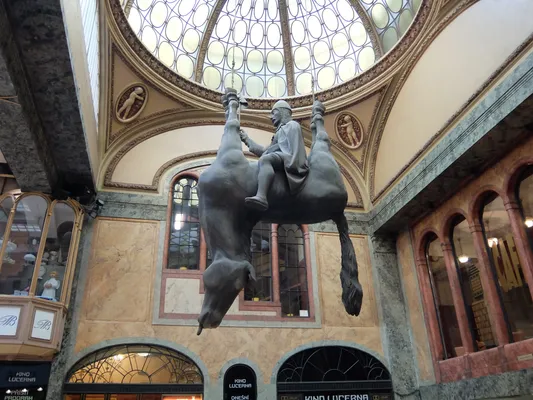
In Lucerna, David Černý's dead horse hangs under the ceiling.
On the façade of Adria stand allegories that look as if they were just about to announce the founding of a new state.
A few streets.
Two different worlds.
If you would like to read more about Lucerna, see also our guide to Lucerna Palace, the Lucerna Passage and the Upside-Down Horse in Prague.
Café Adria – Coffee With a View of Jungmannovo náměstí
On the second floor you will find Kavárna Adria.
It is a good address especially if you want to experience the building as more than a façade.
At the end of the 1920s the well-known concert café Reunion operated here. Today you can sit inside or – weather permitting – on the terrace overlooking Jungmannovo náměstí.
It is not a mysterious café known only to locals.
Nor do you have to pretend the coffee changes your life.
The place simply makes spatial sense.
Sitting there, we begin to understand that Adria was not designed as a single striking front.
It was meant to be an entire urban organism.
The Theatre in Adria Palace
Today the building also houses Divadlo Bez zábradlí.
The theatre has its own contemporary history, but its presence fits the character of the palace perfectly.
In the centre of Prague many stately buildings changed their functions over the decades.
A bank became an office.
A palace, a theatre.
A cinema, a shop.
A shop, a gallery.
The city kept rewriting its buildings.
Adria survived precisely because it is still in use.
Is Rondocubism Found Only in Prague?
No, but it was in Bohemia that the style reached its most characteristic form.
In Prague you can see several very good examples of architecture connected with Cubism and rondocubism.
The best known include:
- the House at the Black Madonna by Josef Gočár,
- the building of the former Legiobanka (Legion Bank) on Na Poříčí,
- Adria Palace,
- the Cubist houses below Vyšehrad.
For anyone interested in architecture, Prague is exceptional in this respect.
Paris has Art Nouveau.
Barcelona has modernisme.
Prague has something that, in such concentration, we will hardly find anywhere else: Cubism in architecture.
Why See Adria Palace?
Not because it is "the most important attraction in Prague".
It is not.
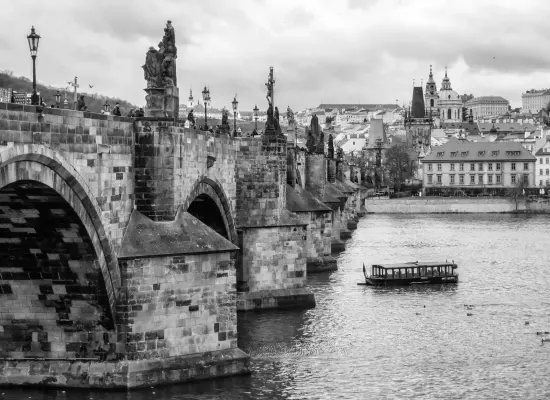
If you are coming for the first time for six hours, you will probably choose Prague Castle, Charles Bridge and Old Town Square.
But if you want to understand the city a little more deeply, Adria is a great stop.
It shows Prague after 1918.
The city of a young state.
The city of architects searching for their own style.
The city of big companies, offices, theatres, passages and cafés.
In other words, the Prague that often cannot be seen from beneath the Gothic towers.
How Much Time Do You Need for Adria?
For a quick look at the façade and a walk through the passage, 10–15 minutes is enough.
If you want to study the details, take photographs and combine Adria with the neighbouring passages, set aside about 30–60 minutes.
The best idea is to treat it as part of a walk:
Národní → Adria Palace → Jungmannovo náměstí → Franciscan Garden → Světozor → Lucerna → Wenceslas Square.
A few hundred metres.
And inside it, almost a whole textbook of 20th-century Prague architecture.
What to See Near Adria Palace
In the immediate area it is worth seeing:
- Jungmannovo náměstí,
- the Church of Our Lady of the Snows,
- the Franciscan Garden,
- the Světozor passage,
- David Černý's Head of Franz Kafka,
- the Lucerna passage and the upside-down horse,
- Wenceslas Square,
- Národní třída,
- the National Theatre.
It is one of the best parts of the centre for strolling without a "must-see" list.
Simply turn wherever the next door opens.
Prague Has a Façade and a Backstage
The best-known cities live a little like a theatre.
Decoration in front.
Corridors behind it.
Prague has Charles Bridge, the Castle and Old Town Square as its grand stage.
But its backstage is just as interesting.
Passages.
Courtyards.
Cafés on upper floors.
Shortcuts between streets.
Adria Palace is one of the entrances to that second city.
Outside, it stands like a fortress.
Inside, it lets people through to the next street.
And that is probably exactly why it is worth going in.
Explore Less Obvious Prague With Us
If places like these interest you more than simply ticking off monuments, see our walks:
- Hidden Prague – Passages, Architecture and City Stories – Adria, Lucerna, Světozor, Rokoko and other passages hidden inside the city;
- Prague in a Nutshell – Everything You Need to See – the classic centre of Prague as a good start;
- Prague in the Shadow of Legends – an evening walk through alleys, stories and city tales;
- All Prague tours with a Polish-speaking guide – current dates and routes.
Frequently Asked Questions About Adria Palace in Prague
Where Is Adria Palace?
Adria Palace is at Jungmannova 31 / Národní 36 in the centre of Prague, a few minutes' walk from Wenceslas Square.
Can You Enter the Adria Passage for Free?
Yes. Public passage through the arcade is free. Individual venues and events have their own admission rules, of course.
In What Style Was Adria Palace Built?
Adria Palace is one of the best-known examples of rondocubism, a specific Czech architectural style developed above all at the beginning of the 1920s.
Who Designed Adria Palace?
The architects connected with the construction were Josef Zasche and Pavel Janák. Zasche developed the basic concept of the building, while Janák played a key role in shaping its characteristic rondocubist façade.
When Was Adria Palace Built?
Today's building was created in the first half of the 1920s and is most often dated to 1922–1925.
Is It Worth Seeing Adria Together With Lucerna?
Definitely. The two palaces are a few minutes' walk apart, and on the way you can pass through the Franciscan Garden and the Světozor passage. It is one of the best short routes through Prague's passages.
What Does Rondocubism Mean?
It is a Czech architectural style that developed the ideas of Cubism through rounded forms: arches, semicircles, circles and cylinders. It is also sometimes described as the Czech national style of the early 1920s.
Sources and Further Reading
In preparing this text we drew on publicly available materials about the history and architecture of Adria Palace:
- Prague City Hall – Palác Adria – information on the construction, the investor, the architects and the sculptural decoration;
- Atlas české architektury – Palác Adria – the architectural character of the building, its authorship and the rondocubist decoration;
- Archiweb – Palác Adria – the history of the project, its authors and the artists responsible for the decoration;
- Prague City Tourism – Kavárna Adria – information on the historic Reunion café and the present-day café in the palace;
- Prague City Tourism – pražská skrytá místa – Adria as part of Prague's network of passages;
- Kavárna Adria – history of the palace – an account of the investor's history, the rebuilding and the characteristic façade.