Unexpected Prague. 21 Secrets of a City Where Beer Is Brewed on a Ship and Coffins Are Served for Dessert
In Prague you can eat a coffin with whipped cream, see Saint Wenceslas riding a dead horse, drink beer in a brewery fitted out on a ship, and learn along the way that “čerstvý” bread is, here, precisely the freshest kind. You can also step off a busy street and, a few paces later, find yourself in a garden where monks grew herbs for centuries. Or wander into a district where the residents had no money, yet their houses bore names full of gold.
This is not, however, a guide to places that “nobody has heard of”. Prague has no need to hide anything in order to surprise. Its greatest secret is that even the sights seen daily by thousands of tourists have a second layer, often funnier, stranger and more human than the story on the first page of a guidebook.
That is also the best reason to return to a seemingly familiar route. Unexpected Prague does not mean avoiding Prague Castle (Pražský hrad), Charles Bridge (Karlův most) or the Old Town Square (Staroměstské náměstí). Sometimes we walk exactly the path everyone else walks, but we look at the details, listen to forgotten stories and notice what others pass by without a thought. Our tours show this in different ways: Prague in a Nutshell uncovers the other side of the Old Town, Royal Prague leads through Nový Svět and Hradčany, and Prague in the Shadow of Legends brings familiar lanes to life with tales of the Golem and ghosts.
So come with us on a walk through unexpected Prague: through passages and courtyards, old inns, sweet pastry shops, the labyrinth of the Czech language and places worth visiting for more than a photograph. Along the way we suggest what to see in Prague beyond the most popular attractions, and what to rediscover even if you already know Charles Bridge by heart.
Prague Flowing with Beer: From a Ship to Breweries Older Than Many Countries
1. Loď Pivovar: Beer Genuinely Brewed on Deck
On Dvořákovo nábřeží, not far from Štefánik Bridge, a ship is moored that from the shore is easily mistaken for yet another restaurant on the Vltava. In fact Loď Pivovar (pronounced loch pivovar) is a working microbrewery with beer-making equipment on board. This is not merely a matter of kegs delivered from land: the beer really is brewed here.
The venue is advertised as the only brewery on a ship in Europe, and Prague’s official tourist portal describes the venture as unique on a European scale. To be safe, we will not call it the only such place in the world, since that record could not be reliably confirmed.
The most interesting thing, though, is the biography of the ship itself. The vessel was built in 1962 in Magdeburg. It was called Sanssouci and sailed in the passenger fleet of Potsdam. Later it became a disco ship, until it finally found its way to Prague. It is roughly 53 metres long. In a person’s life such a career, from elegant cruises through the dance floor to a brewery of one’s own, would count as unusually colourful. In a ship’s life, evidently, too.
On the taps you may find beers named Legie (10°), Republika (12°) and Monarchie (dark, 13°), as well as special batches. On board there is a restaurant and space to admire the view of the river and Hradčany. Anyone who says they have already seen everything in Prague should try drinking a beer here and looking at the city from the deck of a former German pleasure boat.
Where? Dvořákovo nábřeží, berth no. 19, by Štefánik Bridge. Important: this is above all a moored brewery and restaurant, not a regular tourist cruise. Information on reservations and opening hours is worth checking on the brewery’s website.
2. U Fleků: A Brewery That Remembers the Early 16th Century
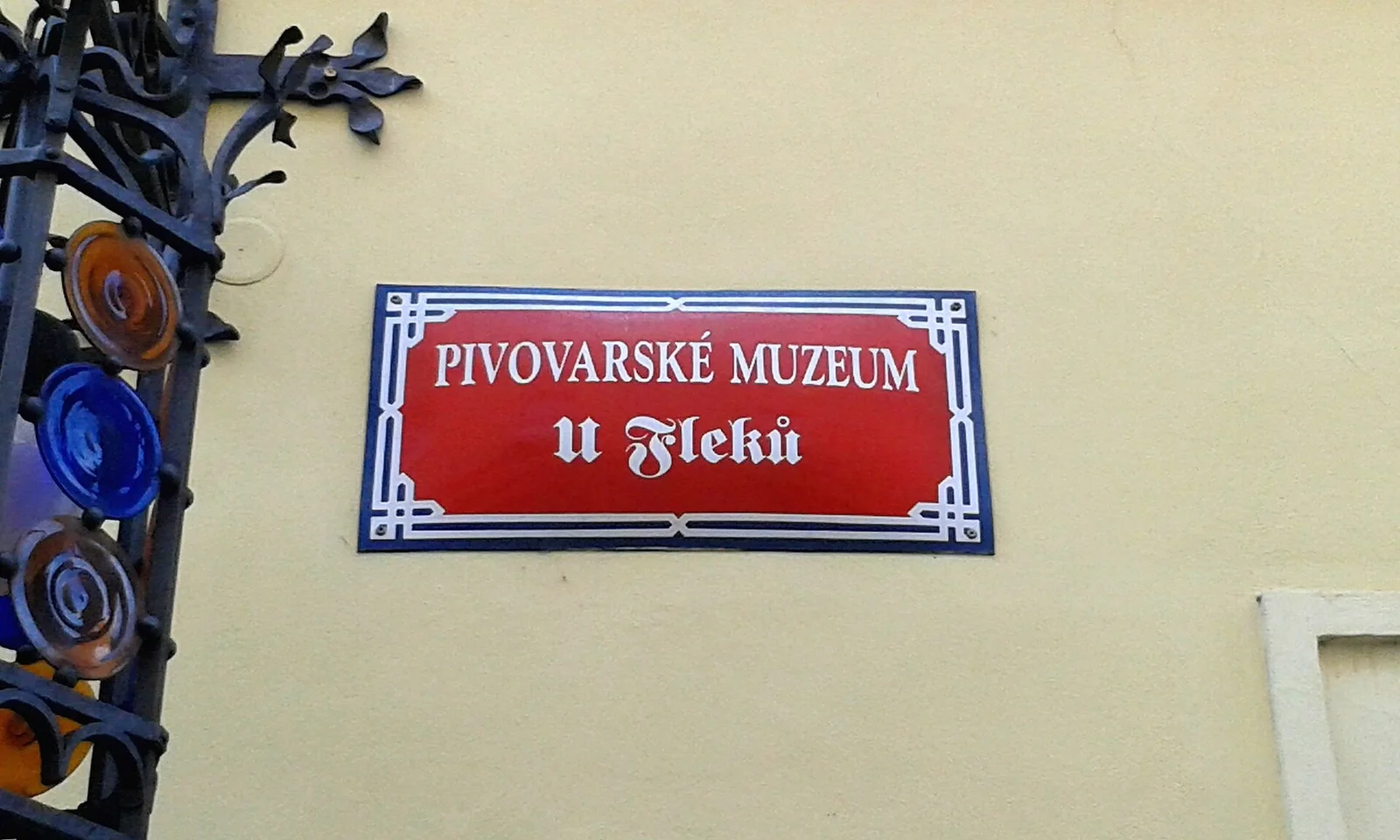
If the walls of Prague’s beer halls could speak, at U Fleků (pronounced oo fleku) on Křemencova Street you would not be able to make your way through the hum of memories. The first written mention of the brewery here dates from 1499. Prague Castle was then ruled by the Jagiellonians, and the world was only just getting used to news of voyages across the Atlantic.
U Fleků is famous for its dark lager, its historic halls and its large courtyard. This is no undiscovered pub for a handful of initiates. Quite the opposite: it is well known and happily visited. What is remarkable is that behind its tourist popularity lies a very long, well-documented history of brewing. According to the brewery, it has continued without interruption for more than five centuries.
Step inside, notice the stained glass, the wooden decoration and the character of a place where beer was long more than a drink: a pretext for conversation, quarrels, celebration and debates about the whole world.
Where? Křemencova 11, New Town (Nové Město). The official history of U Fleků.
3. U Medvídků: 33° Beer, or Thirty-Three of What?
Not far from Národní třída you will find U Medvídků (pronounced oo medveetkoo), a brewery whose tradition reaches back to 1466. Here you can move from the history of old Prague to a small lesson in brewing, thanks above all to the famous XBEER 33°.
No, 33° does not mean 33 percent alcohol. The figure refers to the extract of the wort, that is, its concentration before fermentation, expressed in degrees Plato. It is a different parameter from the percentage of alcohol in the finished beer. The brewery itself presents XBEER 33° as an exceptionally strong beer in terms of extract; there are even claims of “the strongest beer in the world”, but such records should not be confused with the absolutely highest alcohol content.
And if the beer alone is not enough, history adds one more name: according to Prague City Tourism, in 1888 Antonín Dvořák brought Pyotr Tchaikovsky here. If the next table happened to start humming a symphony, it would not be entirely out of place.
Where? Na Perštýně 7, Old Town (Staré Město). U Medvídků brewery.
Czech Sweets: Humour Served with Whipped Cream
4. Rakvička se šlehačkou: A Little Coffin, Please
Rakvička se šlehačkou (pronounced rak-vich-ka se shleh-achkou) does not sound very inviting in translation: a little coffin with whipped cream. Fortunately it is a dessert, not a message from your doctor. In a pastry shop you will usually be handed a light, crisp sweet made from an egg-and-sugar mixture, in shape really resembling a miniature coffin, decorated with a generous helping of cream.
Let us not look for proof of some dark Czech character in it. It is enough to accept that a sense of humour can here take the shape of a dessert. The little coffin is, besides, an ideal opening for a conversation about old Czech pastry shops, where the names of the cakes can be just as delicious as the cakes themselves.
5. Větrník and Věneček: A Choux Puff That Made a Career
Větrník (pronounced vyet-rnyeek) is a large choux pastry with cream and often a caramel glaze. Its smaller, ring-shaped relative, věneček (pronounced vyeh-neh-check), is sometimes filled with vanilla cream and covered in icing. Yes, the association with the Polish ptyś, a cream puff, is perfectly apt, only in a Czech pastry shop the puff often decides to lead a more lavish life.
There are also laskonka (pronounced laskonka), a meringue-and-nut biscuit sandwiched with cream, and likérová špička (pronounced likérova shpichka), a chocolate dessert with a liqueur filling. Our advice: in a small traditional cukrárna (pronounced tsukrarna, a pastry shop), ask about the classic bakes instead of automatically ordering the first trdelník that comes to hand.
6. Trdelník: Is It Really a Prague Treat Since the Middle Ages?
A sweet dough baked on a spit, sprinkled with sugar and cinnamon, is nowadays sometimes presented as an almost obligatory symbol of Prague. Trdelník (pronounced trdelneek) may be tasty, but it is not proof of an unbroken medieval tradition of baking this dessert on every corner of the Old Town. Its popularity in Prague tourism is considerably more recent.
That is why, alongside the trdelník, it is worth getting to know the sweets that are genuinely rooted in everyday Czech pastry-making: the větrník, the věneček or the rakvička. And then deciding for yourself which sweet deserves to be called the tastiest.
7. Chlebíček: A Sandwich That Refuses to Be a Mere Sandwich
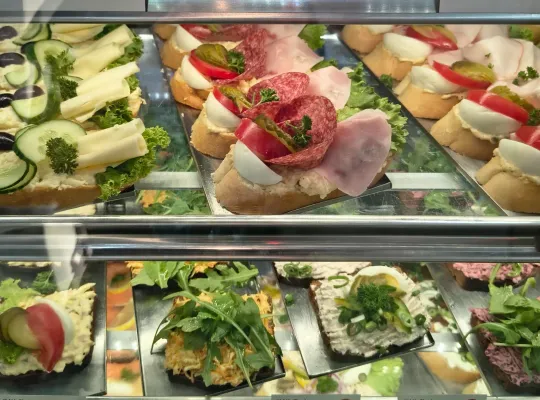
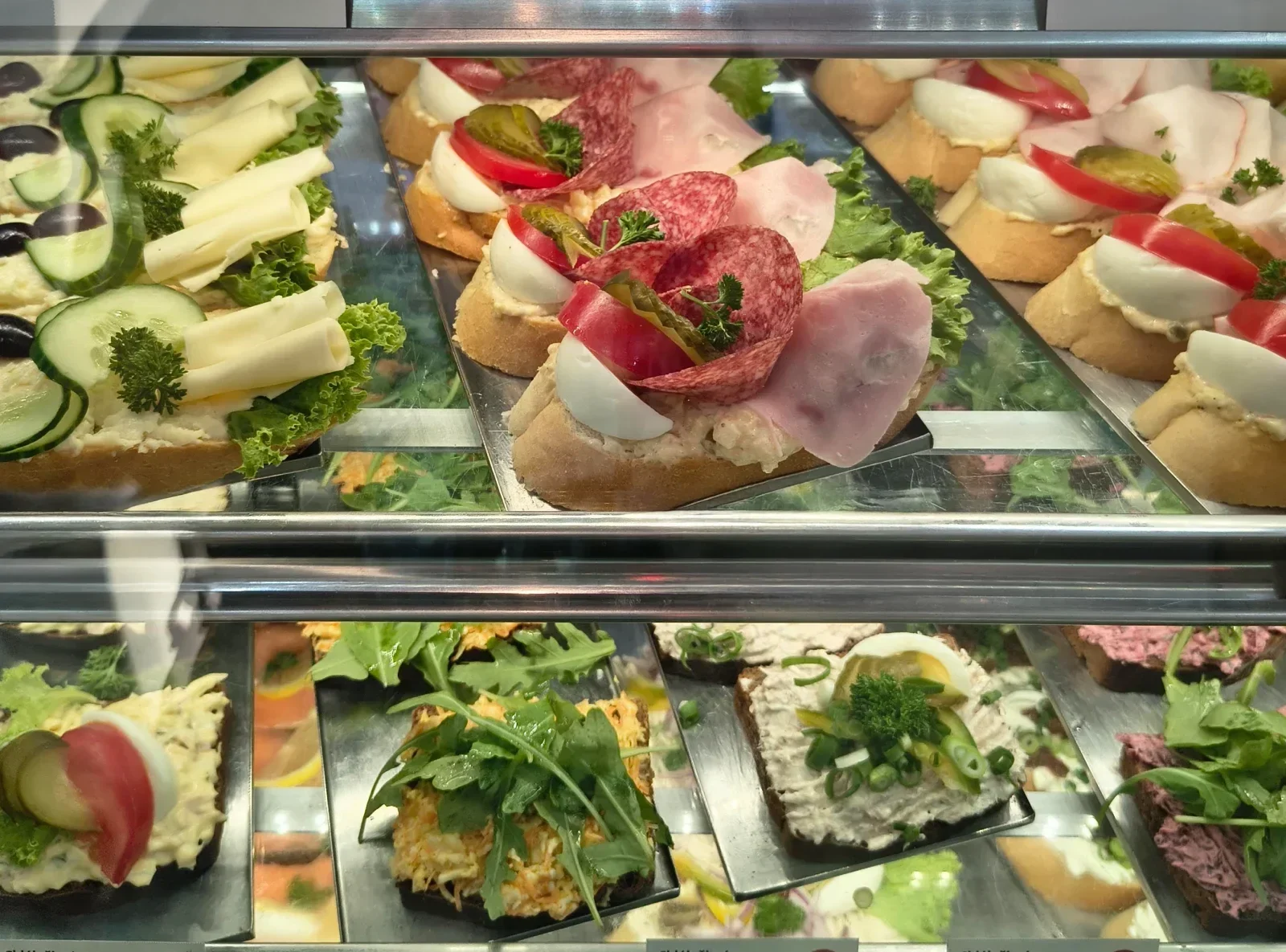
In Czech delicatessens, known as lahůdky (pronounced lahoodky), chlebíčky (pronounced khlebeechky) lie on trays. One slice carries ham, egg, mayonnaise salad, cucumber and sometimes even an artistic composition of vegetables. This is not food designed solely to satisfy hunger quickly. It is a small, edible social ritual.
The popularizer of the chlebíček in its modern form is considered to be the Prague delicatessen owner Jan Paukert, who worked on Národní třída. On your next walk through the centre, remember that a city’s culinary history can be found behind the window of a modest shop, not only in an elegant restaurant.
We described more flavours separately in the article What to Eat in Prague? Czech Snacks and Traditional Dishes.
A Second City Under the Roofs: Prague’s Passages
8. Lucerna: Saint Wenceslas, Who Dismounted in an Unexpected Way
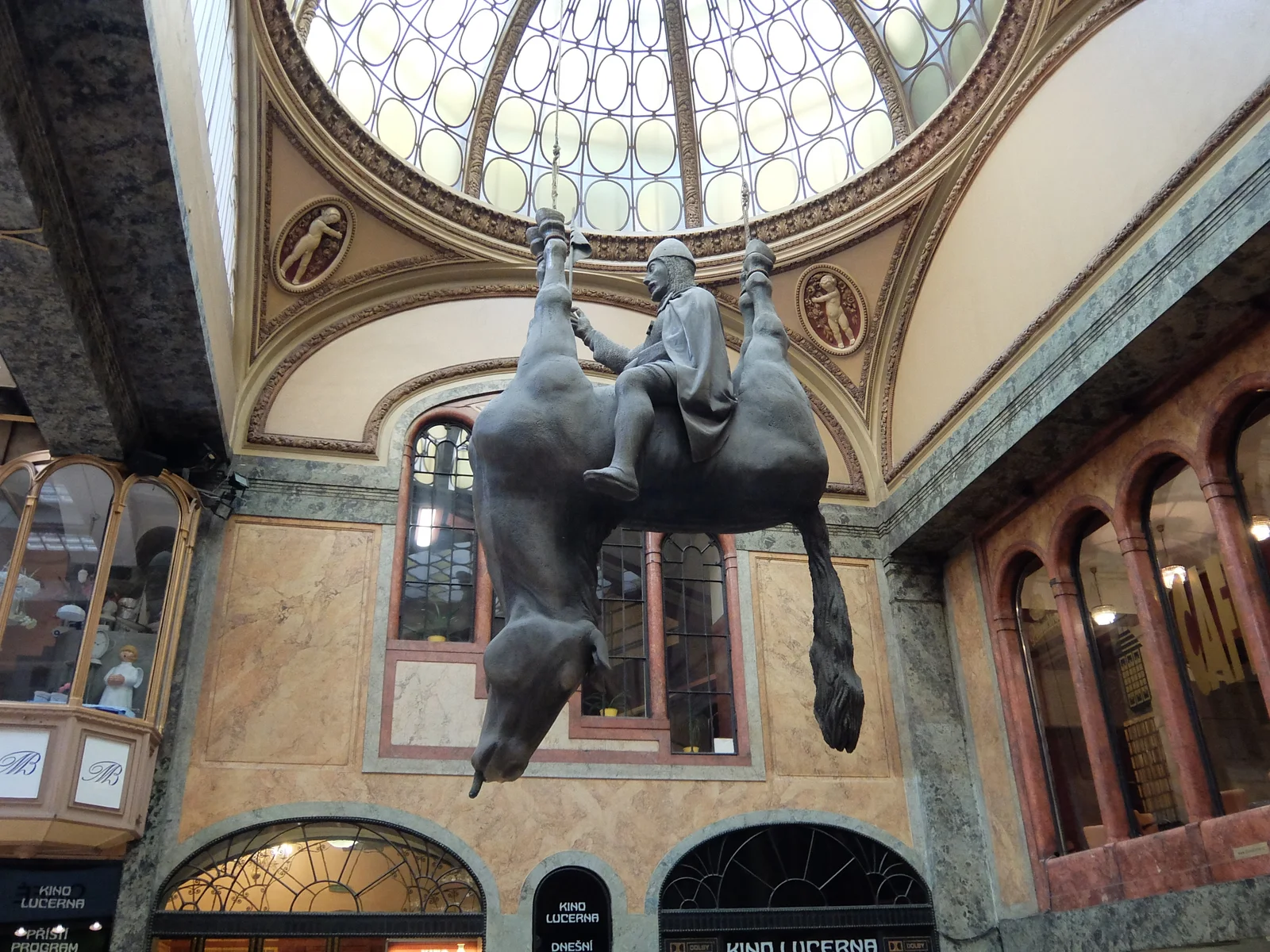
The Lucerna passage in Prague
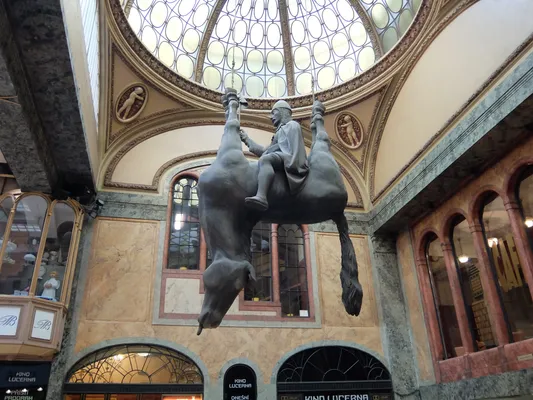
Right next to Wenceslas Square (Václavské náměstí) is the Lucerna passage, one of the most distinctive of Prague’s passage complexes. Beneath the ceiling hangs a sculpture by David Černý: Saint Wenceslas sits on the belly of an upturned horse hanging upside down. It is a provocative reflection of the classic Wenceslas monument in the nearby square.
Prague can speak of its patron in a lofty tone, and a few steps further on it lets an artist turn that solemnity on its head. Literally. In Lucerna, though, it is worth looking at more than the horse: look at the glass roof, the decoration, the halls and the whole world of passages linking busy streets.
9. The Světozor Passage: A Shortcut That Becomes an Attraction
Světozor (pronounced svyeto-zor) is one of the passages around Wenceslas Square, combining everyday city life with cinema and café tradition. Many people pop in only to get from one street to another. And yet the whole pleasure lies in discovering these unassuming connectors of the city: behind one door the noise of the street, behind the next a change of light, smell and pace.
In Prague a shortcut is sometimes more interesting than the destination of the walk. If you want to see what hides behind the façades, join us on Hidden Prague: Passages, Architecture and City Stories. It is precisely a walk through Lucerna, Světozor, Rokoko and lesser-known city passageways.
10. Adria Palace: Architecture That Looks Like a Stone Cake
Not far from Národní třída stands the Adria Palace, a superb example of Czech rondocubism, a style combining monumentality, geometric forms and decoration that here and there resembles stone ornament. Its passage leads to spaces connected with the theatre.
This place teaches one thing: Prague does not end with the Gothic and the Baroque. The 20th century, too, left architecture here that can be admired with your head tilted back.
11. Černá růže: Shopping Under a Glass-and-Concrete Vault
Černá růže (pronounced cherna roozhe, “Black Rose”) links Na Příkopě with Panská Street. Today’s shops may distract from the fact that we are in a monument of modernism. The passage was designed in the 1930s by Oldřich Tyl, and its special ornament is the glass-and-concrete vault and the galleries running along the upper levels.
Visiting the passage requires no special ticket. It is enough to tear your eyes from the shop windows for a moment and look up.
12. The Franciscan Garden: A Green Refuge Hidden in the Crowd
Behind the buildings near Wenceslas Square lies the Františkánská zahrada (pronounced franty-shkanska zahrada), the Franciscan Garden. Once part of a medieval monastery garden, later a place for growing herbs, vegetables and fruit, today it is a peaceful corner with benches and roses.
Its beginnings are linked with the development of the New Town after 1348. From the 17th century the garden belonged to the Franciscans. It was opened to the public after the communist authorities removed the monks in 1950. Part of the beauty of this place is contrast too: from a busy street you can in a short moment move into a world where birds are heard more than trams.
Practically: the garden has set opening hours depending on the season. In the winter season of 2026/2027, according to Prague City Tourism, it is open from 8:00 to 19:00.
Corners You Need Not Discover as the First Person in the World
13. Nový Svět: Golden Names and Poor Houses
A few minutes from Prague Castle lies Nový Svět (pronounced novy svyet), the “New World”. Small houses, cobbled lanes, gently curving alleys: it looks like theatre scenery, but real people lived here, mostly connected with the service of the castle and later often very poor.
The paradox is that many historic house signs here have gold in their names. Golden names by no means meant a golden life. The place began to take shape as early as the 14th century, and today it is associated with artists and with the quieter face of Hradčany.
For whom? For those who want to see a slower, more intimate, almost homely Prague. You will see Nový Svět on our Royal Prague tour. It is an excellent example of how, on a route leading to Prague’s most famous monuments, you can discover little-obvious stories of ordinary people living in the shadow of the royal court.
14. Nerudova: There Was a Time When a House Number Was Not a Given
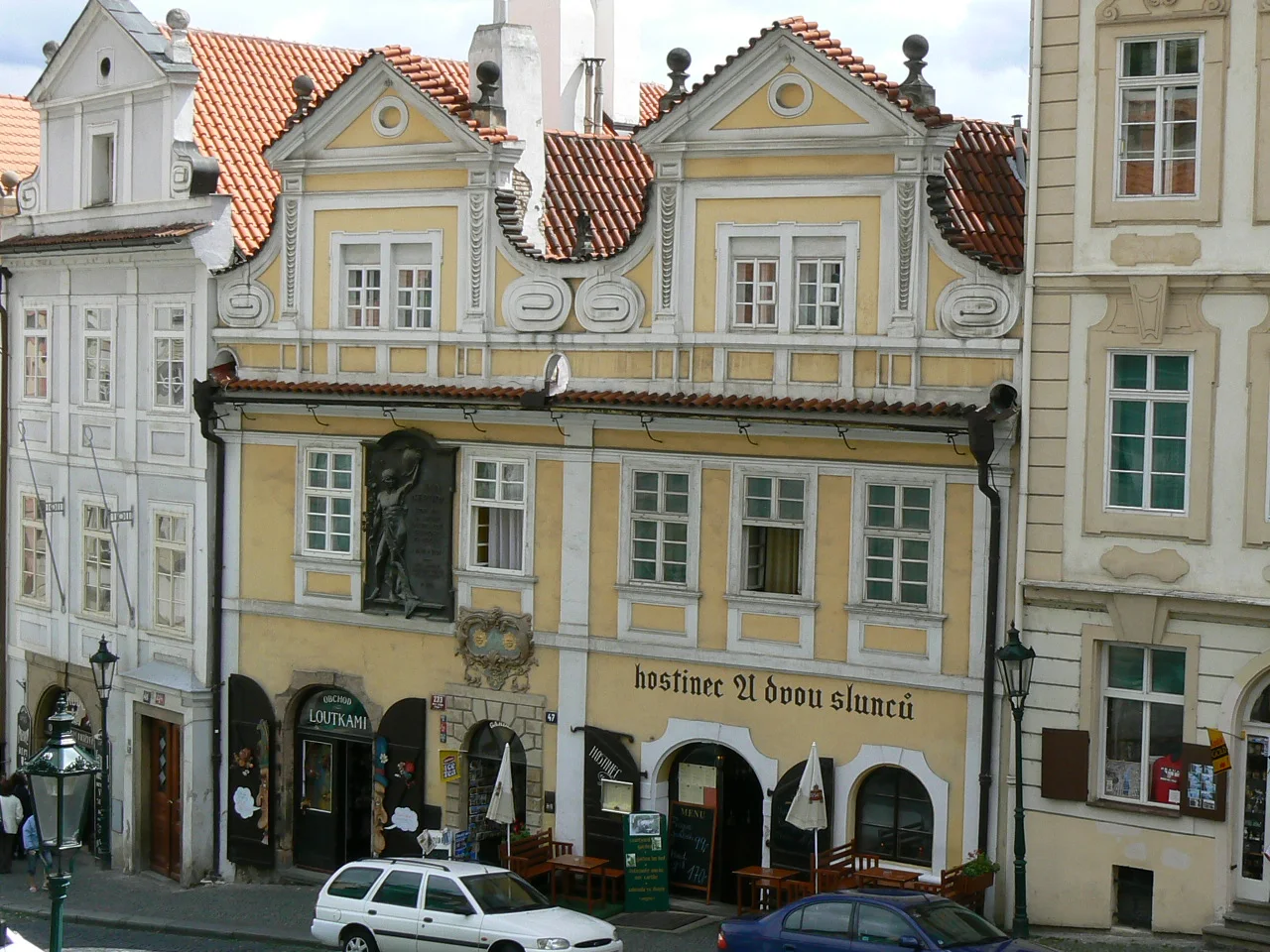
On Nerudova (pronounced neroodova) Street beneath Prague Castle, take a good look at the façades. You will find the houses At the Three Fiddles, At the Two Suns, At the Red Lion and At the Golden Horseshoe. Before house numbering became an everyday matter, house signs helped people find addresses and remember buildings.
Prague’s official tourist service states that the city has preserved more than 260 such signs. It is a ready-made field game: walk along the street and instead of numbers look for animals, objects, suns and instruments. You will see a quite different street from the one seen by those who look only straight ahead.
15. Golden Lane: A Story More Complicated Than the Alchemist Legend
Golden Lane at Prague Castle is associated with the alchemists who were supposed to have searched here for a way to turn metals into gold. The legend is alluring, but the lane’s actual history was more down to earth: the people who lived here served the castle, along with craftsmen and, in later eras, artists too. In the tiny houses you can see how little space an entire household once needed.
Here unexpected Prague does not mean denying the charm of the legend, but setting it beside how the residents really lived. Golden Lane is part of the programme of Prague Castle: A Tour of the Interiors with a Polish Guide, during which we also see St Vitus Cathedral, the Old Royal Palace and St George’s Basilica. The admission ticket for the interiors is paid separately. It is an ideal place to see how much the history of everyday life differs from the colourful legend of the alchemists.
16. Prague’s Pavements: History We Walk On
Next time you admire the architecture overhead, look at your feet as well. Prague’s characteristic stone pavement mosaics have their own patterns and names. Their development goes back to the 19th century, and from 1879 mosaic surfaces were used in the city on a wide scale.
Some patterns have almost poetic names: “stars and crosses”, “dragons”, “frames”. How many times must you walk along a street to notice that even the pavement was designed with artistic ambition?
17. Klementinum: Books, Astronomy and a Less Obvious Face of the Centre
Between Charles Bridge and the Old Town stands the Klementinum, a former Jesuit complex connected with learning, a library and astronomical observations. Many tourists walk past it on their way to Charles Bridge. Yet the history of Prague’s science can be as fascinating as the history of royal coronations.
It is worth remembering that admission to individual interiors depends on the current rules for visiting; not all rooms can be viewed independently.
A Language That Keeps Trying to Lead Us Astray
18. Čerstvý chléb: Fresh, That Is, “Stale”
In a Czech shop, čerstvý chléb (pronounced cherstvy khlep) is fresh bread. This one sign alone shows why a Pole should keep a moderate mistrust in the Czech Republic toward words that seem perfectly familiar. (In Polish, czerstwy means stale.)
Likewise jahody (pronounced yahody) are strawberries, while blueberries are borůvky (pronounced boroovky). If you order a cake with jahody for dessert, you will get something other than the Polish jagodnik, a blueberry cake.
19. Sklep, obchod and záchod: A Geography of Mistakes
In the Czech Republic sklep means a cellar, while a shop is an obchod (pronounced obkhod). When you ask about záchod (pronounced zakhod), you are asking about the toilet, not about the direction in which the sun sets. And pozor (pronounced pozor) means “attention!”, not appearances.
These are examples of false friends: words similar in the two languages but meaning something different. They should not be lumped together with calques, which consist of a literal rendering of a construction or the meaning of an expression from another language. True loanwords and calques deserve a separate article, and here we simply enjoy the linguistic pitfalls.
If you are interested in more such surprises, also read our post Polish and Czech: Two Close Languages That Love Playing Jokes.
20. A Dvanáctka Is Not 12% Alcohol
In a Czech pub you will see desítka (pronounced dessyeetka), jedenáctka (pronounced yedenatska) and dvanáctka (pronounced dvanatska) with your beer. These are terms related to the extract of the wort, not to the percentage of alcohol. So ordering a dvanáctka does not mean you are about to receive a beer of 12 percent strength.
There is also the hladinka (pronounced hladyinka), a classically poured beer with a creamy head; the šnyt (pronounced shnit), a smaller amount of beer with a large portion of foam; and the mlíko (pronounced mleeko), a mug almost full of thick, fresh foam. No, the barman is not trying to cheat you. It is simply that in the Czech Republic even the way beer is poured is a subject of conversation in its own right.
You will find a fuller account in the post Czech Beer Without Secrets.
21. Prague’s Greatest Secret? Stop Walking Only from Monument to Monument
Imagine a day without ticking off a list of attractions. In the morning you step into the Lucerna passage and look at the upside-down horse. Then you walk through the passages and the Franciscan Garden, stopping for a chlebíček or a větrník. In the afternoon you look at the historic U Medvídků brewery, and in the evening you drop by the Vltava to see the brewery on a ship. On another day you discover Nový Svět and search for house signs on Nerudova.
These need not be unknown places at all. It is enough to look more attentively, ask more questions and allow yourself to turn into a passage that seemingly leads nowhere. Prague rewards such detours.
The Familiar Route, but with an Unexpected Story: Choose a Walk with a Polish Guide
What gives us the greatest pleasure is showing the other side of Prague’s best-known places. You need not flee far from the Old Town to discover something unexpected: it is enough to know why three fiddles appear on a house, where the tales of the Golem came from, or how the ordinary inhabitants of the imperial castle lived. Each of our routes shows the same Prague from a different perspective.
Prague in a Nutshell: The Old Town and the Orloj is the ideal beginning. We walk through the most recognizable part of Prague, but instead of merely photographing façades, we learn the stories of people, the details of the buildings and the events whose traces are still visible in the streets. The route starts at Anenské náměstí.
Royal Prague: Nový Svět, Hradčany and Prague Castle lets you combine the royal panorama with the small, once poor houses of Nový Svět. We begin at the Brusnice stop and show that in the shadow of the palaces an ordinary, often difficult life went on too.
Prague Castle: A Tour of the Interiors and Golden Lane is an opportunity to confront the story of the alchemists with the history of the castle guards, craftsmen and residents of the miniature houses. You will also see St Vitus Cathedral, the Old Royal Palace and St George’s Basilica. Admission tickets are an extra charge.
Hidden Prague: Passages, Courtyards and Architecture leads through Lucerna, Světozor, Rokoko and other passageways that for years were city shortcuts and today are also a lesson in architecture, art and the history of everyday life.
Prague in the Shadow of Legends: Ghosts, the Golem and City Tales begins at the Estates Theatre. At night we set out through the Old Town and Josefov (the Jewish Quarter), searching for the boundary between events of long ago and stories that Praguers told one another for generations. We end the walk at Charles Bridge.
Unexpected Prague: Letná, Holešovice and the Shadow of Stalin is, in turn, for those who want to go beyond the postcard centre. From Vltavská, through Holešovice, the metronome and the views from Letná, we make our way towards Hradčany. It is a look at Prague through the history of industry, 20th-century politics and the transformation of the modern city.
These are not identical walks, nor one route covering all the places in the article. What joins them is an idea: even where everyone goes, you can see something that most people do not notice. Current dates can be found in the CzeskaPraga.pl tour calendar.
Unexpected Prague: Frequently Asked Questions (FAQ)
What to see in Prague besides Charles Bridge and Prague Castle?
It is worth walking through the Lucerna, Světozor, Adria and Černá růže passages, looking into the Franciscan Garden, strolling through Nový Svět and searching for historic house signs on Nerudova. It is a good way to see unusual attractions in Prague without travelling far beyond the centre.
Is there really a brewery on a ship in Prague?
Yes. Loď Pivovar is moored at Dvořákovo nábřeží near Štefánik Bridge. On the vessel there are microbrewery equipment, a restaurant and space for guests. The venue advertises itself as the only one of its kind in Europe; however, without further evidence it should not be called the only one in the world.
Does Loď Pivovar sail on the Vltava?
Day to day it operates primarily as a moored brewery and restaurant. A visit to the brewery should not be confused with a regular cruise on the Vltava. Information on possible special events is confirmed by the operator.
What unusual things to eat in Prague?
For something sweet, try rakvičky se šlehačkou, the little coffins with whipped cream, a větrník or likérová špička. For something savoury, choose utopenci (pickled sausages), pickled nakládaný hermelín (cheese) or the classic chlebíčky.
Is entry to Prague’s passages paid?
Simply walking through publicly accessible passages is generally free. Individual buildings may house separately ticketed cinemas, theatres or other attractions, and access to the passageways may depend on opening hours.
Which Prague tour best suits unusual attractions?
It depends on the theme: Hidden Prague is about passages; Royal Prague takes in, among other things, Nový Svět; Prague in a Nutshell lets you look with fresh eyes at the classic centre; Prague in the Shadow of Legends brings the Old Town’s stories closer; and Unexpected Prague leads through Letná and Holešovice. Each uncovers a lesser-known layer of the city.
Sources and Further Reading
- Prague City Tourism: Loď Pivovar and the ship’s history on the operator’s website.
- Prague City Tourism: Prague’s passages, Černá růže and the Franciscan Garden.
- Prague City Tourism: Nový Svět and house signs.
- U Fleků brewery: history and Prague City Tourism: U Medvídků.
- Prague City Tourism: the history of Prague’s pavement mosaics.
Information about venues, the availability of interiors and opening hours may change; check their websites before your visit.