Czech Beer Without the Mystery. Why a Dvanáctka Is Not 12% Alcohol, and a Glass Full of Foam Is No Swindle
You step into a Prague pub. The wooden tables have heard more than one debate about politics and ice hockey, a waiter squeezes between the chairs with a tray full of glasses, and behind the bar someone performs an almost balletic routine at the tap. The menu reads: desítka, jedenáctka, dvanáctka. A tourist orders the twelve, thinking he is about to receive a beer with the strength of a light wine. The Czechs merely smile.
Because in the Czech Republic beer is not simply a drink. It is a language, a custom, a piece of history and – as you will quickly find out – a separate science of foam. When sightseeing in Prague with a Polish-speaking guide, it is worth understanding at least a few words of that language. It changes the way you look at the menu in a pub, and at the city itself.
Desítka, Jedenáctka and Dvanáctka. What Do the Numbers on Czech Beer Mean?
The most important thing to know: the Czech 10°, 11° and 12° do not mean percent alcohol. The numbers describe the original extract content of the wort – that is, roughly, the amount of dissolved substances (mainly from malt) before fermentation. They are degrees Plato, not the strength of the finished drink.
| On the menu | In Czech | Pronounced (approx.) | What it means | Approximate alcohol* |
|---|---|---|---|---|
| 10° | desítka | DEH-seet-ka | 10° original extract | usually about 3.5–4.3% |
| 11° | jedenáctka | YEH-deh-nahtst-ka | 11° original extract | usually about 4–4.8% |
| 12° | dvanáctka | DVAH-nahtst-ka | 12° original extract | usually about 4.5–5.3% |
The ranges are approximate. Check the actual strength on the label or in the menu, because it depends on the recipe and the degree of fermentation.
A desítka will often be lighter and crisper, a dvanáctka fuller, with a more pronounced malty character. But this is not a simple rule of "the higher the number, the better the beer". A good ten can be more enjoyable than a mediocre twelve. Flavour is also shaped by hops, water, yeast and the brewer's craft.
A curiosity: in Czech regulations the traditional classification also takes the type of beer into account: výčepní pivo is most often a beer with a lower extract, and ležák a lager from the higher range, usually 11–12°. So the word ležák is not the name of a brand.
How Pilsner Conquered the World, and What a Prague Tailor Has to Do with It
Let us travel to Plzeň (Pilsen), to the year 1842. The townspeople were not delighted with the quality of the local beers. So they invested in a new brewery and brought in the Bavarian brewer Josef Groll. On 5 October 1842 he brewed the first batch of the beer that was to change the world: pale, golden, bottom-fermented, with a distinct hoppy bitterness.
Today you will meet the word pilsner on bottles from America to Asia. But it began with a specific town, a specific recipe and a man whose name fewer people know than the taste of his invention.
And Prague? Here appears the favourite hero of this story: Jakub Pinkas, a tailor by trade. According to the brewery's history, in April 1843 he received a delivery of Pilsen lager from a friend, Martin Salzmann. He was so delighted with it that he swapped the tailor's trade for running an inn. That is how the tradition tied to U Pinkasů was born – one of the best-known addresses of beer Prague.
You do not have to be a beer expert to appreciate this story. In 19th-century Prague, from a glass of the new drink grew an entire social institution. Craftsmen, journalists, politicians, artists and ordinary residents met in the pubs. The conversations were often longer than the beer ordered.
Why Do the Czechs Like Foam? Hladinka, Šnyt and Mlíko
In Poland, a customer often eyes a glass with a thick head of foam with suspicion. In the Czech Republic a well-poured, dense and moist head is an important part of serving beer. It protects the aroma, affects the sense of taste and shows the technique of the person behind the bar – the výčepní, or tapster.
Hladinka (HLAH-din-ka) – the Classic to Get to Know First
This is the standard pour: most of the glass is filled with beer, and on top sits a distinct, creamy cap of foam, often described as about three fingers thick. A well-prepared hladinka does not resemble the stiff, dry foam of washing-up liquid. It is delicate, wet and settles with time.
Šnyt (shnit) – for Those Who Want "Just a Little More"
The word is pronounced roughly "shnit". In a large glass you get a smaller portion of beer, a good amount of foam and empty space at the top. It is a fully fledged way of serving, not a short pour. In the past such a small glass could be a way of ending the evening when you no longer felt like another full beer.
Mlíko (MLEE-ko) – the Glass That Looks Like Milk
In Czech the name means "milk". The glass is dominated almost entirely by delicate, moist foam, with a small amount of liquid beer at the bottom. It is best drunk relatively quickly, before the foam subsides. Thanks to the way it is served it can seem milder, creamier and sweeter. It is not a milk beer, and no milk is added to it.
And What About Beer Without Foam?
You may come across the term čochtan – a way of serving with a minimum of foam. It is less protected from contact with air, so it is best drunk quickly. It is more a curiosity to compare than a mandatory item on a first visit to a Czech pub.
Do the Czechs Really Drink Beer from Morning On?
The image of a Czech with a tankard at breakfast is above all a tourist stereotype. Beer has long been a part of social life, but that does not mean every Prague resident drinks every day, or that Czech culture comes down to alcohol. In pubs you also meet families, friends drinking non-alcoholic nealko and people who have simply come for lunch.
There are, however, customs that can surprise. In some traditional venues, after the first order the waiter may offer or bring the next beer when the previous one is running out. On the table there is sometimes a slip of paper on which the staff mark strokes for each further order. It is not a universal rule – if you do not want another glass, a clear Ne, děkuji ("No, thank you") is enough.
Beer mats, in turn, are not just a souvenir from a trip. In some pubs, placing a mat on your glass can signal that you have finished drinking, but it is better not to treat this gesture as a rule that applies everywhere.
Light, Dark or Half-Dark? A Small Glossary of the Prague Beer Menu
In brackets we give an approximate English pronunciation of the Czech words:
- Světlé (SVYET-leh) – light beer.
- Tmavé (TMAH-veh) – dark, often with roasted, caramel or chocolate notes.
- Polotmavé (POL-o-tmah-veh) – half-dark, amber.
- Ležák (LEH-zhahk) – lager; in the Czech Republic also a category traditionally tied to original extract.
- Nefiltrované (NEH-fil-troh-vaneh) – unfiltered, may be cloudy.
- Kvasnicové (KVAS-nee-tsoh-veh) – yeast beer, depending on the particular product.
- Řezané (RZHEH-za-neh) – a blend of light and dark beer, whose availability depends on the venue.
- Točené (TOH-cheh-neh) or čepované (CHEH-po-va-neh) – draught beer.
- Lahvové (LAH-hvo-veh) – bottled.
- Nealko (NEH-al-ko) – non-alcoholic.
What to Order with Czech Beer? Man Does Not Live by the Glass Alone
Beer in the Czech Republic keeps excellent company. Among the most characteristic snacks are utopenci (oo-toh-PEN-tsi) – sausages pickled with onion in a sour brine, nakládaný hermelín (NAK-la-da-nee HER-meh-leen) – cheese pickled with spices, and pivní sýr (PIV-nee seer) – a pungent cheese served in various farmhouse versions. Crispy bramboráky, or potato pancakes with garlic and marjoram, also go very well.
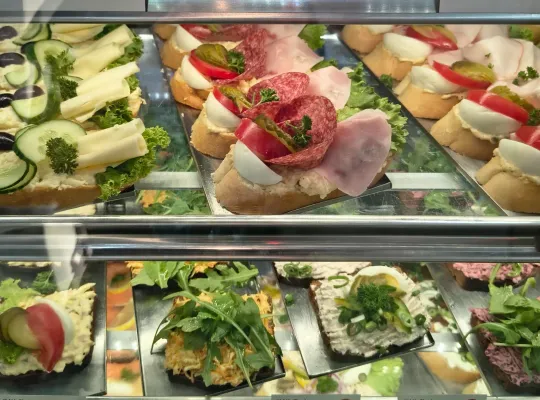
Instead of ordering yet another portion of chips at random, turn to our separate guide to Czech snacks and traditional dishes. There we also explain where the famous chlebíčky came from, what hides behind the name svíčková and whether trdelník really is an ancient Prague speciality.
How to Order Beer in Czech? Sentences That Come in Handy
This is a simplified pronunciation for the English-speaking visitor, not a strict phonetic transcription. Long Czech vowels are held slightly longer, and the characteristic ř is hard to render in English letters.
| In English | In Czech | How to say it |
|---|---|---|
| One large beer, please | Jedno velké pivo, prosím. | YED-no VEL-keh PI-vo, PRO-seem |
| One small beer, please | Jedno malé pivo, prosím. | YED-no MA-leh PI-vo, PRO-seem |
| Do you have non-alcoholic beer? | Máte nealkoholické pivo? | MAH-teh NEH-al-ko-ho-LITS-keh PI-vo? |
| I'll have a twelve, please | Dám si dvanáctku, prosím. | dahm si DVAH-nahts-tku, PRO-seem |
| I'll have a šnyt, please | Dám si šnyt, prosím. | dahm si shnit, PRO-seem |
| No more, thank you | Už ne, děkuji. | oozh neh, DYEH-ku-yi |
| Can I pay by card? | Můžu platit kartou? | MOO-zhoo PLA-tit KAR-tow? |
| The bill, please | Zaplatím, prosím. | ZA-pla-teem, PRO-seem |
You do not have to speak perfect Czech. A few words in the local language are usually enough to make the conversation with the waiter start on a friendlier note.
Where Does the History of Beer Meet the History of Prague?
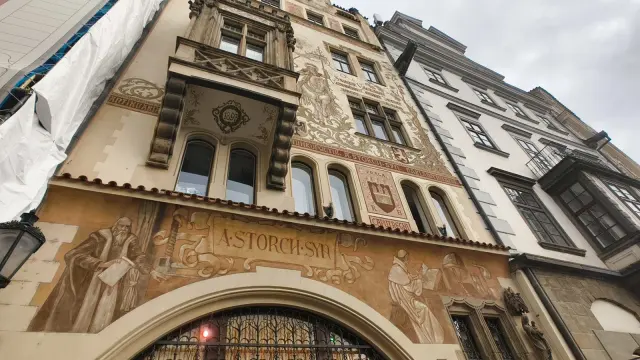
Prague is not a vast museum of brewing with one mandatory exhibit. It is rather a city whose old pubs, burghers' houses and cobbled lanes form a fascinating map of everyday life. In the area of Národní třída, the Old Town and Wenceslas Square you can tell the story not only of kings, but also of Prague craftsmen, restaurateurs, poets and urban customs.
See Prague with a Polish-speaking guide from CzeskaPraga.pl. On our walks around the Old Town and the historic centre you will get to know places that are easy to pass by when looking only at your phone's map. We talk about history, architecture, legends and the life of the city, adding curiosities that make Prague stay in the memory. Our tours are not alcohol tastings – but after a walk it is much easier to choose a pub where you can rest and try local flavours.
Check the tours of Prague and plan a day that combines sightseeing with the pleasure of getting to know Czech cuisine.
Most Frequently Asked Questions About Czech Beer – FAQ
Does a Czech 12° Beer Have 12 Percent Alcohol?
No. The number denotes the original extract of the wort in degrees Plato. Most popular dvanáctkas have about 5% alcohol, but the exact value must always be checked for the particular beer.
Which Is Stronger: Desítka or Dvanáctka?
Usually the dvanáctka, although degrees Plato should not be equated directly with percent alcohol. The actual strength depends on the fermentation and the recipe.
Why Is So Much Foam Poured in the Czech Republic?
A moist, fine head is part of the traditional way of serving and affects aroma and flavour. An excessive amount of dry foam, however, is not a synonym for a good pour.
What Is Mlíko in a Czech Pub?
It is a way of pouring beer with a dominant amount of creamy foam. It contains no added milk.
How Does a Šnyt Differ from a Small Beer?
A šnyt is a specific technique of pouring a smaller quantity of beer into a larger glass, with a thick layer of foam and empty space. A small beer, by contrast, simply means a standard smaller volume of the drink.
How Do You Say "Cheers" in Czech?
Na zdraví! It is best said with a smile, whether you are holding a glass of beer or a glass of a non-alcoholic drink.
In Closing: in the Czech Republic Beer Is a Story
First there is the number on the board. Then the foam we do not understand. Finally the story of a tailor who gave up the needle for pilsner, and of a city that turned the pub into a meeting place. You can come to Prague for a weekend, drink a beer and leave. You can also sit down for a moment, look around and see how many stories fit around a single glass.
Because in the end, the most interesting thing about Czech beer is not only what is in the glass, but also what happens around it.
Sources and Further Reading
- Plzeňský Prazdroj – brewery history, Josef Groll and Jakub Pinkas
- Pilsner Urquell – three ways of pouring beer
- VisitCzechia – the tradition of pouring Czech beer
- Brewers Association – beer styles and original extract
This article is cultural and touristic in nature. If you do not drink alcohol, in Czech venues you will also find more and more good non-alcoholic options.