What to Eat in Prague? From Drowned Sausages in Vinegar to the Queen of Czech Sauces
Prague smells of more than history. It smells of fresh caraway bread, roast pork, garlic, marjoram and beer, which in a Czech pub is not a side note to lunch but a full participant in the gathering. Anyone who comes here looking only for goulash and dumplings has discovered just the first page of the menu. And the best treats, literally and figuratively, often hide at the very end of it, in the modest section headed něco k pivu, “something to go with beer”.
What should you eat in Prague to get to know real Czech cuisine? Start with the snacks: utopenci, pickled hermelín and chlebíčky. Then comes the time for garlic soup, fried cheese, svíčková and roast duck. And for dessert? Best something with poppy seeds, plum jam or quark. Here is our subjective guide, generously seasoned with curiosities.
Czech Snacks to Go with Beer – Small Dishes, Big Character
Utopenci (pronounced oo-toh-PEN-tsee) – Czech “Drowned Men” Who Enjoy Vinegar
Some dishes have charming names, others sound like the announcement of a disaster. Utopenci literally means “drowned men”. What you get on the plate, though, is not a murder mystery but thick špekáček-style sausages pickled in a brine of vinegar, water, onion and spices. They can be spicy or milder, but they should always have a decisive character. They are served cold, usually with bread.
It is worth noting a simple Czech rule: a snack to go with beer is meant to whet the appetite, not necessarily to satisfy it. Sour onion and a fatty sausage make a duo that works surprisingly well with a pale lager. If you like pickles, the utopenec will feel like a familiar relative, though one with a distinctly Czech personality.
Nakládaný hermelín (pronounced NAH-klah-dah-nee HER-meh-leen) – the Cheese That Went for a Bath
Another pub classic is nakládaný hermelín: a soft white-mould cheese, similar to Camembert, marinated in oil with garlic, onion, peppers and spices. A ripe hermelín turns creamy and robust; it tastes best with good bread, which you can use to mop up the fragrant marinade.
The name hermelín alludes to ermine fur, a white, noble coat. In a Czech pub, though, this “aristocracy” lands on an ordinary little plate, often alongside a hot chilli. Good! Democracy at the table is one of the more likeable Czech traditions.
Tlačenka s cibulí (pronounced TLAH-chen-ka s TSIB-oo-lee) – Head Cheese Without Complexes
Tlačenka is a close relative of the Polish salceson (head cheese), most often served in thick slices with onion, vinegar and bread. It is not a dish that poses beautifully for the catalogue of a luxury restaurant. But in a traditional pub it tells you more about the local cuisine than many an elaborate plate. It is part of the Central European tradition of using meat without wasting its good cuts.
Pivní sýr (pronounced PIV-nee seer) and Olomoucké tvarůžky (pronounced OH-loh-mohts-keh TVAH-roozh-ki) – a Proposition for Brave Noses
If you see pivní sýr (beer cheese) or olomoucké tvarůžky on the menu, prepare for intense aromas. Tvarůžky is a ripened cheese associated with the area around Olomouc; it is famous for its pronounced smell and strong taste. It is not a snack for everyone, but it is worth checking at least once whether your nose and palate share the same opinion.
Topinky (pronounced TOP-in-ki) – Garlic Toasts That Pretend to Be Nothing
Topinky are slices of bread fried or toasted until crisp, usually rubbed with garlic and salted. Sometimes they come with a meat or cheese spread. Simple? Almost brazenly so. But after a whole day of sightseeing in Prague they can taste more convincing than a showy starter with a name half a menu long.
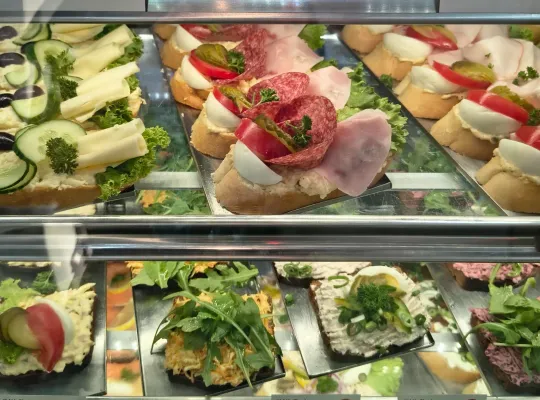
Chlebíčky (pronounced KHLEH-bee-chki) – Prague Open Sandwiches with Social Ambitions
In Poland we buy a sandwich when we are hungry. In the Czech Republic the obložený chlebíček is also part of the culture of get-togethers: birthdays, celebrations, receptions and quick visits to the delicatessens known as lahůdky. On a fluffy slice of bread there is room for potato salad, ham, egg, cucumber, cheese and a little decorative fantasy.
There is also a Prague historical thread. The man credited with popularising the chlebíček in its present form is Jan Paukert, who in 1916 opened a delicatessen with his wife on what is now Národní třída. According to the family story, the inspiration was a painter dissatisfied with tiny canapés: he needed something “for two or three bites”. And so, as the legend has it, the chlebíček was born, bigger than a jednohubka, smaller than an ordinary sandwich.
Tip: when you see a lahůdky sign, look inside. The chlebíčky there are often more interesting than the snacks offered on the most crowded tourist streets.
Hot Czech Snacks That Can Replace Lunch
Smažený sýr (pronounced SMAH-zheh-nee seer) – Breaded Cheese That Rose to Hero Status
Smažený sýr, affectionately called smažák, is breaded and fried cheese, most often served with chips or potatoes and tartar sauce (tatarská omáčka). Do not look for the finesse of French cuisine here: what you will find is a golden crust, a stretchy centre and enormous satisfaction. Especially when the cheese is freshly fried.
Bramborák (pronounced BRAM-bo-rahk) – the Czech Potato Pancake with Marjoram
A Pole sees bramborák and thinks: “potato pancake”. Right, but only partly. The Czech version is distinguished above all by garlic and marjoram. It can be served on its own, with cabbage or with a meat accompaniment. The best bramborák has crisp edges and a fragrant centre, and it needs no complicated sauce to vanish from the plate.
Klobása (pronounced KLO-bah-sah) and Párek v rohlíku (pronounced PAH-rek v ROH-lee-ku) – Street Food Czech Style
Klobása is grilled sausage, and párek v rohlíku is the Czech hot dog, often a frankfurter pushed into a hollowed-out roll. The latter is more an everyday, practical snack than a national culinary monument. At tourist spots it is worth checking whether the price of the sausage refers to the whole portion or to 100 grams.
What to Eat for Lunch in Prague? Five Czech Classics
Svíčková na smetaně (pronounced SVEECH-ko-vah na SMEH-ta-nyeh) – the Sauce Around Which the Whole Lunch Revolves
On the plate you will see slices of tender beef, a pale, creamy sauce of root vegetables, houskové knedlíky (bread dumplings), and often also cranberries, a slice of lemon and whipped cream. To the uninitiated the combination may look peculiar. But it is precisely the contrast of sweetness, gentle acidity and the flavour of the meat that gives it its charm. The Czechs rightly treat svíčková as a festive dish.
Vepřo-knedlo-zelo (pronounced VEP-rzho-KNED-lo-ZEH-lo) – the National Shorthand
Three words, three foundations: pork, dumplings and cabbage. Roast meat, slices of dumpling soaking up the gravy, and braised sauerkraut make a lunch after which sightseeing is best continued with a calm stroll. Not a race up the stairs of a tower.
Guláš (pronounced GOO-lahsh) – the Hungarian Cousin with a Czech Passport
The Czech hovězí guláš (beef goulash) is usually thicker than the goulash soup known from Hungary. Plenty of onion, meat, spices, dumplings, and one more occasion to appreciate how Central European cuisines borrow ideas from one another and then declare them their own.
Pečená kachna (pronounced PEH-cheh-nah KAKH-na) – Duck, Cabbage, Dumplings
Pečená kachna (roast duck) arrives at the table with cabbage and dumplings, sometimes in a version with two kinds of cabbage or different dumplings. It is the classic choice for a longer lunch, when there is no need to hurry anywhere any more.
Kulajda (pronounced KOO-lai-da) and Česnečka (pronounced CHES-nech-ka) – Two Soups, Two Temperaments
Kulajda is a creamy, slightly sour soup with potatoes, mushrooms, dill and often an egg. Česnečka is the garlic answer to a cold Prague day: warming, usually with croutons, sometimes with cheese and potatoes. Not every soup in the Czech Republic has to be heavy, but both can effectively restore the mood of a tired tourist.
Czech Sweets: Poppy Seeds, Plum Jam and One Tourist Trap
Instead of automatically buying a trdelník, look in a bakery for a koláč with quark (tvaroh), poppy seeds (mák) or plum jam (povidla). Try also the yeast-dough buchty, the bábovka cake, the creamy větrník or ovocné knedlíky, sweet dumplings with fruit, butter and quark. In Czech cuisine a sweet dish can be a full lunch, not only a dessert.
And the trdelník? You do not have to avoid it. If you like a sweet, hot pastry with sugar and cinnamon, tuck in. But do not let anyone convince you that a huge roll filled with ice cream is an age-old delicacy of the Old Town. It is above all a modern symbol of the tourist streets. The tradition of baking dough on a roller has existed in the region for a long time, but today's Prague product is not a hallmark of old Prague cooking.
A Little Glossary: How to Order Food in Czech
The pronunciation given below is a simplified rendering for English speakers, not a phonetic transcription. Czech long vowels (á, é, í, ý) are pronounced longer; the Czech ř has no exact English equivalent.
| In Czech | How to read it in English | What you will get |
|---|---|---|
| Něco k pivu | NYETS-oh k PIV-oo | Snacks to go with beer |
| Utopenci | oo-toh-PEN-tsee | Sausages in vinegar marinade |
| Nakládaný hermelín | NAH-klah-dah-nee HER-meh-leen | Marinated white-mould cheese |
| Obložený chlebíček | OB-loh-zheh-nee KHLEH-bee-chek | An open sandwich with toppings |
| Smažený sýr | SMAH-zheh-nee seer | Cheese fried in breadcrumbs |
| Bramborák | BRAM-bo-rahk | Garlic-and-marjoram potato pancake |
| Svíčková na smetaně | SVEECH-ko-vah na SMEH-ta-nyeh | Beef in creamy sauce |
| Houskový knedlík | HOHS-ko-vee KNED-leek | Bread dumpling |
| Bramborový knedlík | BRAM-bo-ro-vee KNED-leek | Potato dumpling |
| Bez masa | bez MAH-sa | Without meat |
| Dobrou chuť! | DOH-broh khoot | Enjoy your meal! |
If you do not know where to start, say: “Dám si nakládaný hermelín, prosím” (pronounced “dahm si NAH-klah-dah-nee HER-meh-leen, PRO-seem”), “I'll have the pickled hermelín, please”. Or simply point at the dish on the menu. The Czechs value simplicity, especially at the table.
Where to Look for Good Czech Food in Prague?
Do not judge a restaurant by the number of wooden barrels and the sign “traditional Czech food”. Look for shorter menus, dishes of the day (denní nabídka), local guests and prices stated clearly beside each portion. For snacks, go to an ordinary hospoda or pivnice, and for chlebíčky to the lahůdky. You do not need to go far outside the centre, but sometimes it is enough to turn off the busiest street.
What to Watch Out for When Ordering?
- Knedlík is not a pierogi. It often plays the role of bread or an accompaniment to sauce.
- Tatarská omáčka is tartar sauce, a very frequent companion of smažený sýr.
- A portion of meat may be priced by weight in grams; check the side dishes and their price.
- Sausage from a stall may be charged by weight. Ask for the final price before ordering.
- Czech cuisine also has excellent meatless dishes: fried cheese, bramboráky or sweet dumplings. It is worth checking the stock or the accompaniments, though.
Prague Tastes Best When You Know Its Stories Too
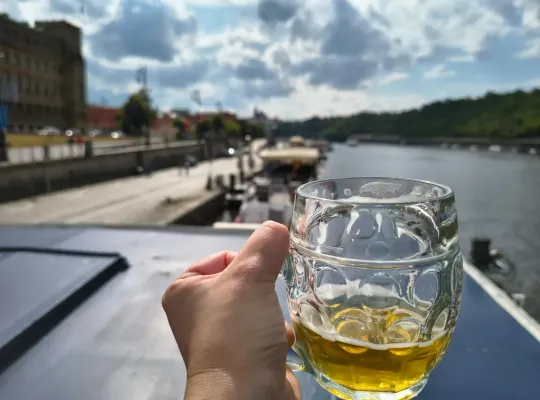
You can eat a chlebíček and move on. You can also find out why its Prague career began precisely on Národní třída. You can drink a beer by Old Town Square and then discover how, over the centuries, the city's pubs, marketplaces and the customs of its residents have changed.
That is why sightseeing in Prague with a Polish-speaking guide combines so well with getting to know Czech cuisine. On our walks we talk about the life of the city, its inhabitants, legends and less obvious corners; along the way we also suggest which local treats are worth looking out for. These are historical and sightseeing tours, not organised tastings, but after such a walk it is easier to choose a pub and order something more than the first item on the tourist menu.
Check our tours of Prague:
- Prague in a Nutshell – the Most Important Places and Plenty of Curiosities
- Royal Prague – a Walk Through the History of the City
- Prague in the Shadow of Legends – an Evening Face of the City
Plan a walk with CzeskaPraga.pl, and after sightseeing sit down at a table and check whether you rank hermelín, utopenec or a proper svíčková higher. In Prague such disputes are best settled over a plate.
FAQ – What to Eat in Prague?
What Are the Most Typical Czech Snacks?
The classics include utopenci, nakládaný hermelín, tlačenka with onion, topinky and chlebíčky. Many of them are served cold, with bread, as snacks to go with beer.
What Should I Eat in Prague for My First Lunch?
If you eat meat, try svíčková na smetaně or vepřo-knedlo-zelo. For cheese lovers a good start is smažený sýr with potatoes and tartar sauce.
Is Trdelník Traditional Czech Food?
Dough wound around a roller has a long history in Central Europe, but today's Prague version sold to tourists, especially when filled with ice cream, is not an old speciality of the Old Town. Koláče and buchty are the more local choice.
What Can I Eat in Prague Cheaply and Quickly?
Look for chlebíčky in lahůdky, soups in places with a daily menu, bramboráky and simple sandwiches. Before buying food at a stall, check the price and the size of the portion.
Is There Anything for Vegetarians in Czech Cuisine?
Yes: smažený sýr, some bramboráky, fruit dumplings and many baked goods. You do need to check the ingredients, however, because cabbage, sauces and soups are sometimes prepared with meat or lard.
When planning your culinary discoveries, it is also worth consulting the guide of the Czech tourist organisation VisitCzechia. Remember that menus and the availability of dishes may differ between venues.