Jimbo Herndan at English Wikipedia / Wikimedia Commons, Public domain · Creative Commons
Prague loves to pretend it is an old city.
It does so brilliantly.
It showcases Gothic towers, Baroque domes, saints standing motionless on stone pedestals, and facades that look as if no one has dared to touch them in centuries.
And then you turn a corner.
Sigmund Freud is hanging above the street.
In the Lucerna Passage, Saint Wenceslas sits on a dead horse suspended upside down.
In front of the Franz Kafka Museum, two naked men are urinating into a pool shaped like the Czech Republic.
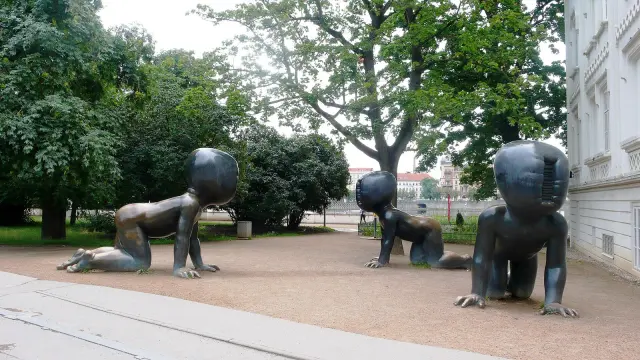
Climbing up the Žižkov Television Tower are enormous faceless children.
A few streets away, the metallic Kafka Head unfolds into rotating layers and, moments later, reassembles into a familiar face.
This is not a second Prague.
It is still the same city.
Just without the postcard filter.
And behind much of this controlled chaos stands David Černý.
So, if you are looking for something more in Prague than the Charles Bridge, Old Town Square, and Hradčany, Černý’s sculptures are one of the best ways to dive into unconventional, alternative, and slightly cheeky Prague.
Who is David Černý?
David Černý is one of the most recognizable contemporary Czech artists.
But calling him merely a "sculptor" says far too little about him.
Černý uses sculpture, mechanics, architecture, provocation, and the Czech sense of absurdity. His works rarely function inside museums; instead, they operate directly in urban space.
And that is the key to understanding them.
Černý’s sculptures rarely exist simply to "look nice."
They are meant to annoy.
To surprise.
To provoke.
Sometimes to amuse.
Other times to make a passerby unsure for a few seconds whether they are looking at art, a joke, political commentary, or pure madness.
In Prague, this language works exceptionally well.
Because Czechs have long harbored a special suspicion of pompousness.
In the land of Hašek, Hrabal, and Kafka, a hero can easily turn into an anti-hero, grandeur into grotesque, and a national monument into a joke.
Černý exploits this perfectly.
David Černý and Prague – Why are his sculptures everywhere?
The largest gallery of David Černý is the city itself.
His works are not viewed exclusively in an orderly exhibition hall.
You encounter them while shopping.
In passages between streets.
Overhead.
In courtyards.
Next to shopping centers.
On towers.
Beside modern apartment blocks.
Some have become tourist attractions.
Others can still be easily missed.
And that is exactly why walking in the footsteps of David Černý in Prague is more interesting than simply ticking sculptures off a map.
In reality, it is a walk through the Czech mentality.
Through the systemic transformation.
Through national symbols.
Through the Czech relationship with their own history.
And through a specific humor where you often laugh first, and only later realize the joke was about you, too.
The Kafka Head in Prague
One of the most photographed contemporary sculptures in the center is David Černý’s Kafka Head, standing near the Quadrio complex.
It is a monumental metal head built from moving layers.
For a while, everything looks calm.
You see a face.
Then the individual levels begin to shift.
The nose drifts one way.
The forehead moves the other.
The face ceases to exist.
Moments later, it reassembles.
Kafka returns.
And then, shortly after, vanishes again.
It is hard to imagine a more Kafkaesque monument.
When does the Kafka Head rotate in Prague?
This is one of the most common questions from tourists seeking this sculpture.
The mechanism operates on programmed sequences, so before making a special trip just to see the sculpture move, it is worth checking the current schedule on-site.
However, the movement is only half the attraction.
The most interesting moment is when the human face breaks apart into geometric fragments.
Kafka is turned into a machine.
A human into a mechanism.
It is very Prague.
And very Černý.
The Hanging Freud in Prague
This sculpture is very easy to miss.
The reason is simple:
most people look straight ahead.
Here, you need to look up.
A man is hanging above the street.
He holds onto a metal structure with one hand.
He looks as if he is about to fall.
This is Sigmund Freud.
The sculpture, known as The Hanging Freud in Prague, Man Hanging Out, or Viselec, is one of Černý’s most characteristic works.
Freud does not stand on a pedestal.
He does not sit majestically at a desk.
He hangs.
Literally.
You can see uncertainty in the intellectual here.
A crisis of the modern man.
A question about the boundary between control and collapse.
Or simply an excellent Czech joke placed a few meters above tourists' heads.
Černý usually leaves the viewer enough room to choose their own version.
Lucerna Palace and Saint Wenceslas on a Dead Horse
If you enter Lucerna Palace Prague into your map, it is worth not ending your tour at the beautiful interior of the passage.
Look up.
You will find one of David Černý’s most famous sculptures.
Saint Wenceslas sits on a horse.
Only the horse is dead.
It hangs upside down.
Its tongue lolls out of its mouth.
And Wenceslas still sits on its belly with the dignity of a man who apparently hasn’t received the news that the entire monumental scene has just collapsed.
It is hard not to think of the famous statue of Saint Wenceslas standing on nearby Wenceslas Square.
And that is precisely the power of Černý’s work.
A few hundred meters away, we have a national symbol placed according to all rules of monumentality.
Here, that same symbol is turned upside down.
Literally.
Lucerna Passage in Prague – Worth visiting even for one sculpture
Lucerna Passage is itself an interesting fragment of central Prague.
However, for those seeking the art of David Černý, the Horse – Kůň located there is a must-see.
It is a good example of how the most interesting contemporary attractions in Prague are sometimes just a few steps from places visited by thousands.
You just need to know where to look.
The Pissing Men in front of the Franz Kafka Museum
In the Lesser Town, in the courtyard of the Franz Kafka Museum, stands another work by Černý.
Two male figures stand facing each other.
Between them is a tank shaped like the Czech Republic.
And the figures are pissing into it.
Yes.
It is public art.
And yes.
We are only a few minutes' walk from the Charles Bridge.
The work is known as Proudy, Piss, or simply The Pissing Men.
This is Černý in pure form.
The state is turned into a pool.
A monument into a fountain.
Grandeur into physiology.
You can see political commentary in it.
You can see a joke about national solemnity.
You can also shrug your shoulders and take a photo.
All three reactions are part of this work.
Miminka – Babies on the Žižkov Television Tower
If you have ever seen photographs of the Žižkov Television Tower, you probably noticed something strange.
Gigantic babies are crawling along the structure.
These are Miminka, or Babies, by David Černý.
Their faces lack normal features.
They have been replaced by a characteristic, non-human indentation resembling a code or a mechanical seal.
From a distance, they look almost funny.
Up close, they begin to be unsettling.
And it is precisely between these two feelings that Černý feels most at home.
Žižkov – Prague beyond the postcard
The trip to the tower has another advantage.
It takes you beyond the most obvious center.
Žižkov is a completely different Prague than the area around the Astronomical Clock.
More everyday.
Less polished.
Full of pubs, steep streets, tenement houses, and places that don’t try to pose as tourist attractions.
If you are interested in alternative Prague, these are exactly the districts worth adding to your plan.
Lilith in Prague
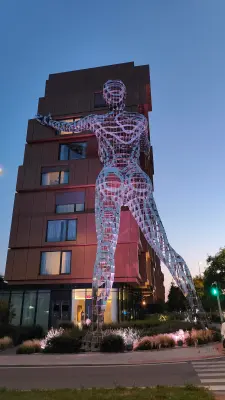
One of the newer and most monumental projects associated with Černý is Lilith in the Karlín district.
The enormous female figure has been integrated directly into modern architecture.
It does not stand in front of the building like a traditional monument.
It enters into a physical relationship with it.
It holds it.
It embraces it.
It dominates the facade.
This is a completely different scale than The Hanging Freud or the small Embryo.
Yet the principle remains similar:
the viewer is meant to stop and ask:
what exactly am I seeing here?
Along the way, it is a good reason to visit Karlín – a district that shows a completely different face of contemporary Prague.
Embryo – A sculpture easy to miss
Not all of Černý’s works are enormous.
Embryo, or Embrion, works exactly the opposite way.
Embedded in a fragment of urban space, it can go unnoticed by someone who doesn’t know of its existence.
And that is one of the pleasures of touring Prague in the footsteps of contemporary art.
Suddenly, you discover that the city has layers.
One is for everyone.
The second is for those who know the history.
The third is for those who look more closely.
Černý, Kafka, and Czech Absurdity
Linking David Černý with Kafka might seem like an easy move.
But both share a similar problem with Prague.
They don’t let it be comfortable.
Kafka could turn an office into a nightmare, a trial into a labyrinth, and ordinary life into a situation whose rules no one explained to the human.
Černý does something similar with public space.
Everything looks familiar.
A monument.
A horse.
A head.
A man.
A child.
A car.
It is only after a moment that we notice something is wrong.
The horse is dead.
The head is falling apart.
The man is hanging over the street.
The child has no face.
The car has legs.
It is reality shifted by a few centimeters.
Enough to recognize it.
And enough to feel uneasy.
Unconventional Prague – The City of David Černý
The greatest advantage of walking in Černý’s footsteps is that it leads through very different parts of the city.
From the tourist center.
Through the Lesser Town.
Lucerna.
Žižkov.
Karlín.
All the way to places where most people don’t even arrive during their first weekend in Prague.
That is why David Černý’s sculptures in Prague are something more than a list of strange objects.
They create an alternative map of the city.
A map based not on kings, churches, and wars, but on provocation, irony, and contemporary art.
If you like this kind of Prague, also check out our tour Brutalism – Letná. It is another way to discover the city beyond the classic postcard center.
For a first contact with Prague, Prague in a Nutshell is better, and if you prefer darker stories and urban tales – Prague in the Shadow of Legends.
All current tours can be found on – Polish Guide to Prague.
More sculptures beyond the classic centre
Trifot: the hybrid that looks back
Trifot — Czech Photo Centre, 2016
Travel farther out to Nové Butovice and the setting becomes more contemporary, with fewer classic sightseeing crowds. In front of Czech Photo Centre stands something resembling a camera after a particularly strange dream. Trifot, roughly twelve metres high, combines a tripod, cameras and the suggestion of a mechanical creature. It appears ready to move.
The camera grows legs
Photography traditionally has a clear arrangement: a person looks, a camera records and an object is observed. Černý reverses that relationship. Trifot is larger than a person, its lenses resemble eyes and its electronics allow it to respond to the surroundings. Images of passers-by can appear on nearby screens.
You come to photograph art, and the art begins looking at you. In the twenty-first century, it is an immediately recognisable theme: street cameras, phones, social media, surveillance, algorithms, location data and facial recognition. We spend the day photographing the world while being recorded ourselves.
Who is taking whose picture?
You look at Trifot; Trifot looks at you. You take out a phone and photograph it. The situation becomes comic: one device records another device that resembles a living device observing a person. Technology supplies much of the joke without further explanation.
See Czech Photo Centre for the venue and current programme. Outdoor viewing and entry to an exhibition are separate experiences.
Brown-Nosers: climbing into political satire
Brown-Nosers — Futura, 2003
Some works defeat elegant language about contemporary art. This is one: two enormous lower human bodies, without heads or faces, but with ladders. The viewer climbs up to look into an opening in the buttocks. The physical action is part of the work, rather than something observed from a respectful museum distance.
The ladder changes your role
You have to participate: climb, approach and put your head somewhere social convention normally tells you not to. Inside, a video depicts Václav Klaus and Milan Knížák, feeding one another while Queen plays. The work addresses the Czech political and cultural establishment of its time through a deliberately literal version of the English expression “brown-noser”.
There is little mystery about the central metaphor: someone will do almost anything to get close to power. Černý turns flattery into a physical location and requires the spectator to enter it.
Why it works without knowing every politician
You do not need the biographies of both figures to recognise the mechanism. Names, parties and political systems change, while someone continues climbing the ladder and trying to get close enough to authority. The installation makes that direction unusually literal.
This is a work with explicit anatomical imagery, not necessarily an appropriate stop for every family. Check Futura's current access and programme before making a special journey; a historical description does not guarantee that an installation is available every day.
Quo Vadis: the Trabant that leaves the road
Quo Vadis — German Embassy, 1990
The Trabant is not a car automatically associated with freedom. In Central Europe, its plastic body, simple construction and East German identity evoke shortages, queues and everyday life under state socialism.
Then came 1989. East Germans sought refuge at West German embassies, including Prague's. Cars were left around the embassy: Trabants and Wartburgs whose owners were leaving much more than a vehicle behind.
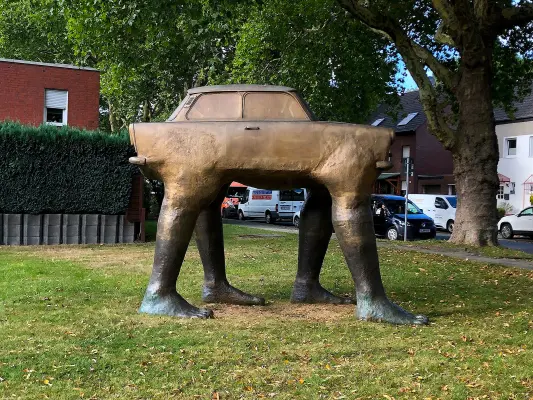
Černý gives the car human legs
In 1990, Černý created Quo Vadis, a Trabant with four human legs. The car no longer needs the road; it can walk away. The work is connected with the refugee crisis around the West German Embassy in Prague. A bronze cast stands in the German Embassy's garden.
Its title means “Where are you going?” In 1990, that question could be addressed to Germany, Czechoslovakia and Eastern Europe as a whole. What direction would follow communism? The car walks rather than drives, like a person who abandoned a vehicle because the journey mattered more.
The structure of the work is characteristic: first comes the visual joke, a Trabant with legs; then the history opens behind it. Embassy grounds have their own access rules, so check viewing arrangements rather than assuming free entry to the garden.
Tanks and fragments: a monument loses its certainty
The tank motif and A Hundred Grams of Tank — Náměstí Kinských
To understand Černý's tanks, return to 1991. Prague had a Soviet tank monument commemorating the city's liberation by the Red Army. It was heavy, solemn and treated as untouchable. Černý painted it pink.
The gesture turned a symbol of military force into something absurd. The artist was detained, the act provoked public debate and it became one of the events that made him widely known.
The tank is still a tank
He did not need to destroy or dismantle the machine. A changed colour altered its authority. The gun, armour and tracks remained, but some of its monumental menace disappeared.
Later works return to tanks and their fragments. A Hundred Grams of Tank at Náměstí Kinských uses a section of a T-34 in a renewed comment on the monument and memories of Soviet presence. Tank Torso belongs to the broader vocabulary of the artist's tank-related works. Distinguish individual works and locations rather than treating every title as the same object.
What remains when power's monument changes?
First the monument declares victory. Then the political system changes and the monument becomes a problem. Someone paints it pink; later there are fragments. Is a piece of tank still a symbol of power or a museum remnant? Černý is interested in that moment when a symbol loses confidence.
London Booster: a bus doing push-ups
London Booster — Chodov, 2012
A red London double-decker does push-ups. It is difficult to make the sentence more solemn. Černý created London Booster in connection with the 2012 London Olympics, adding enormous mechanical arms to the familiar British vehicle. Hydraulics raise and lower the bus: a machine built for transport appears to exercise.
Sport or punishment?
Černý linked the idea of push-ups with punishment as well as sport: misbehave, and do fifty. Hydraulic machinery, electronics and LED screens turn a practical vehicle into something resembling a body.
You can stop at the joke, but the Olympic setting offers more: sport, money, national representation, media, advertising, politics and millions watching bodies perform things most viewers cannot. Alongside that spectacle, a red bus exercises, looking both ridiculous and heroic.
The work is associated with Chodov. As with Kafka's Head and other kinetic pieces, check the current location and operating arrangements rather than assuming the mechanism moves continuously.
Why do cities have so many monuments?
A short history of long shadows
From imperial columns to socialist giants, monuments can serve power by fixing a preferred account of the past. They shape collective memory, often in idealised form. Each period and society has its own reasons for building them.
Long before statues celebrated named rulers, monumental stones such as the Neolithic pillars of Göbekli Tepe served ritual and communal purposes. In ancient Egypt, royal images such as the Great Sphinx and statues of Ramesses expressed authority, divinity and endurance. The Stele of Hammurabi, from the eighteenth century BCE, connects image, text and social order in stone.
Rome's Trajan's Column turned the monument into a sculpted narrative of imperial victory. Later national and political monuments, from Napoleonic imagery to statues of Lenin, helped define a nation, instruct citizens and legitimise authority.
Three purposes recur:
- Sacred meaning and collective memory: honouring gods, the dead or heroes.
- Political propaganda: giving power a durable visible form.
- Control over historical narratives: choosing what should remain and what people should see.
Černý's works react against that code. In place of grandeur comes absurdity; in place of glory, grotesque imagery; in place of a settled message, a question. The monument becomes something through which viewers argue rather than an object that delivers the final word.
Art integrated with architecture
In socialist Czechoslovakia, an investment system operating from the mid-1960s directed a share of public building budgets towards art. Often discussed as “four-percent art”, it produced sculptures, fountains, mosaics and reliefs beside schools, hospitals, sports buildings and housing estates. Art was part of a building project rather than a decoration added later.
With the political and economic changes after 1989, that model ceased to structure investment in the same way. Advertising and commercial imagery took over much public space, although the memory of a city speaking through art remained. Some earlier artworks disappeared during redevelopment.
Černý's independent and provocative work comes from a city shaped by that presence of public art. It questions what a sculpture says, to whom and in what historical context, rather than simply whether art belongs outside. His works redefine the purpose of a public object: they unsettle familiar narratives and encourage reflection.
Monuments as stories about society
Near the Bethlehem Chapel, Embryo is easy to miss on a building's downpipe. It does not need a grand pedestal to raise questions about what is visible, hidden or acceptable in public space, and what development means biologically or socially.
The inverted horse in Lucerna similarly tests a national image. Its joke becomes a way to examine symbols dulled by repetition, commerce or routine. Entropa used national stereotypes to challenge a polished image of European unity, provoking controversy and showing that a monumental work can operate as a distorting mirror as well as a tribute. Sometimes caricature reveals what an idealised portrait conceals.
FAQ – David Černý and his sculptures in Prague
Where is the Kafka Head in Prague located?
David Černý’s Kafka Head is located at the Quadrio complex in central Prague.
When does the Kafka Head rotate?
The sculpture is kinetic and performs programmed movement sequences. Since the operation method may change due to technical or organizational reasons, it is worth checking current information on-site before visiting.
Where is The Hanging Freud in Prague?
The Hanging Freud must be sought high above the street in the historic center. Many people walk under it without noticing it at all.
Where is David Černý’s horse?
The sculpture Kůň, depicting Saint Wenceslas sitting on a dead horse, can be seen in Lucerna Passage in Prague.
Where are David Černý’s children?
The most characteristic Miminka are located on the Žižkov Television Tower.
Is it worth touring Prague in the footsteps of David Černý?
Yes, especially if you already know the most important landmarks and are interested in unconventional Prague, contemporary art, Czech humor, and places off the standard tourist route.
Prague Doesn’t Always Want to Be Beautiful
And perhaps that is exactly why it is interesting.
You can come here for the Charles Bridge.
You can come for Hradčany.
You can come for the beer.
But after a few days, you begin to discover another city.
A city that can place a national hero on a dead horse.
Hang Freud above the street.
Unfold Kafka into metal slices.
Place enormous children on a television tower.
And do all of this without explaining to the passerby what they are supposed to think.
David Černý did not create this feature of Prague.
He simply understood it brilliantly.
Because beneath all the towers, palaces, and facades lies another Prague.
An ironic Prague.
Rebellious.
Absurd.
One that doesn’t like monuments standing too straight.
And once you have seen it, it is very hard to return to the postcard.