VitVit / Wikimedia Commons, CC BY-SA 4.0 · CC BY-SA 4.0
Prague is one of Europe’s most beautiful cities – a mosaic of history, architecture, and an atmosphere found nowhere else. Choosing the right neighborhood for your stay can completely change how you experience the city. Rather than sticking to the beaten path, let’s explore six districts worth considering. Each has a distinct character – from the vibrant streets of the Old Town, through the artistic vibe of Žižkov, to the modern galleries of Holešovice.
***
Lesser Town – the romantic heart of Prague
Nestled at the foot of Prague Castle (Google Maps), Lesser Town (Malá Strana) enchants with cobblestone streets, lush gardens, and an atmosphere of bygone eras. It is the ideal choice for those seeking tranquility without sacrificing proximity to the city’s top attractions. As you stroll toward Charles Bridge (Karlův most) (Google Maps), you’ll find charming cafes, small galleries, and baroque palaces. Lesser Town is particularly captivating in the evening, when the crowds of tourists gradually dissipate, and the city assumes a more intimate character.
***
Žižkov – artistic vibe and nightlife
If you want to feel a more alternative side of Prague, choose Žižkov (Google Maps). This is a district of bars, small art galleries, and original eateries where life truly begins after dark. The neighborhood revolves around iconic pubs and alternative clubs, but Žižkov is also home to the Žižkov Television Tower (Google Maps), offering panoramic views of the entire city. The lower part of the district feels more raw, while the upper areas are filled with atmospheric cafes and beautiful townhouses.
***
Old Town – right in the heart of Prague
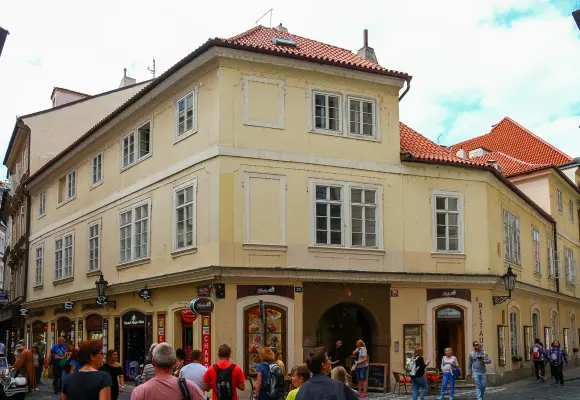
Old Town (Staré Město) (Google Maps) is the choice for those who want to be at the center of the action. Walking through its cobblestone alleys, you’ll stumble upon Old Town Square, the famous Astronomical Clock (Orloj), and countless restaurants and cafes. Staying here means being close to the most important landmarks, but it also comes with higher prices and large crowds of tourists. If you crave the atmosphere of a historic center and don’t mind the noise, the Old Town is perfect.
***
Holešovice – the city’s modern face
Just a few decades ago, Holešovice (Google Maps) were an industrial district; today, they are one of Prague’s most creative hubs. Here you’ll find modern galleries like the DOX Centre for Contemporary Art (Google Maps), trendy restaurants, and alternative cultural spaces. It is an ideal choice for those seeking something less touristy and wanting to feel the rhythm of contemporary Prague.
***
Vinohrady – elegance, parks, and cafes
Vinohrady (Google Maps) is an elegant, green district with beautiful townhouses, local markets, and a peaceful atmosphere. Popular meeting spots include Náměstí Míru Square (Google Maps) and Jiřího z Poděbrad Square (Google Maps), both filled with fashionable cafes and restaurants. This is a great option for those who want to escape the tourist hustle while remaining close to the center. Vinohrady blend the vibe of local Prague with convenient access to public transport.
***
New Town – between history and modernity
New Town (Nové Město) (Google Maps) is where history meets the dynamism of modern life. This is where you’ll find Wenceslas Square, the National Museum (Google Maps), and hundreds of restaurants, bars, and shops. New Town is perfect for those who want to combine sightseeing with shopping and exploring urban nightlife. If convenient transportation is a priority, this is one of the best locations.
***
Summary
Prague is a city of many faces. If you want to be at the center of the action, choose the Old Town or New Town. For a romantic atmosphere, Lesser Town is ideal, while Vinohrady and Žižkov offer a local vibe. Holešovice, on the other hand, will be loved by fans of contemporary art and modern architecture. Each district offers a different history, a different rhythm, and different possibilities – choose the one that fits your travel style.
Three questions before choosing a neighbourhood
- Do you want to step straight out into the historic centre? Look at Old Town, New Town and Lesser Town.
- Do crowds and noise bother you? Consider Vinohrady, upper Žižkov or Holešovice, while checking the specific street and room.
- How much does price matter? A central address carries a premium. Just outside the core, you may find more space or a breakfast café that suits you better.
Prague's dense PID network makes travel easier, but check the actual journey from the hotel address to your intended destination. District names alone do not tell you how long a journey takes. Read the practical guide and Prague transport in 2026.
Transport, noise and trade-offs in each district
Old Town suits a first visit of two or three days if you dislike commuting. You can walk to many landmarks and choose from numerous restaurants and cafés. The trade-offs are higher prices, crowds, weekend noise and cobbles under your suitcase wheels. Metro connections include Staroměstská and Můstek on line A and Náměstí Republiky on line B. Check the exact meeting point if booking a centre-based tour.
Lesser Town offers an atmospheric setting below the castle and evening walks among Baroque palaces and old houses. Its hills and paving matter if you have luggage or limited mobility. Restaurants along the busiest tourist routes can be expensive, and low-cost accommodation is less plentiful. Metro A at Malostranská and trams serve the area; check your particular address rather than assuming everything is close to the station.
New Town is convenient for railway arrivals and has a wide range of hotels. Lines A, B and C meet within the broader central area at stations including Můstek, Muzeum and Hlavní nádraží. It is not uniformly postcard-like, and parts of Wenceslas Square can be noisy at night. For a gentle start after a train journey, see Prague from the Main Railway Station.
Vinohrady combines parks, cafés and residential streets. Metro A at Náměstí Míru and Jiřího z Poděbrad, together with trams, provides access to the centre. Travel time still depends on the walk from your accommodation to the stop. Check prices and noise for the actual property. Read what to see in Vinohrady.
Žižkov suits visitors interested in pubs and alternative culture, but it is not an automatic choice for silence. Some streets are less polished, and late-night venues can affect nearby rooms. Trams provide access to the centre; journey times vary by address. See Žižkov, its television tower and Vítkov.
Holešovice suits contemporary art, architecture and repeat visits. Letná and Stromovka are nearby, while central monuments require a journey. Metro C at Vltavská and Nádraží Holešovice and the tram network serve the district. Check the lines operating on your travel dates.
| District | General character | Typical trade-off |
|---|---|---|
| Old Town | Historic and busy | Convenience versus price and crowds |
| Lesser Town | Atmospheric and historic | Castle access versus hills and paving |
| New Town | Central and well connected | Transport choice versus variable street noise |
| Vinohrady | Residential streets and cafés | Local rhythm versus a journey to Old Town |
| Žižkov | Alternative culture and nightlife | Interesting venues versus evening noise |
| Holešovice | Contemporary art and former industry | Fewer classic sightseeing crowds versus travel to monuments |
These are broad tendencies, not guarantees about a hotel, price or journey time.
Where to stay on a first visit
For two nights, the ease of starting and ending each day matters most. If you plan Old Town one day and the castle the next, choose an easy walk or a straightforward connection. You do not need a room beside the square to see it early in the morning.
Check the actual route from the hotel to the stop. Two addresses at a similar distance from an attraction may mean very different journeys: one tram or several changes and an uphill walk. Avoid repeated inconveniences on a short trip.
If arriving by train, compare the walk from the station with journeys to your sightseeing priorities. Railway proximity helps with luggage but should not be the only criterion. For a late arrival, check reception hours and how you collect the keys.
Where to stay with children
Choose a particular room and its surroundings before choosing a district. Useful features include enough proper beds, convenient breakfast, luggage storage and a simple return at midday. With a pushchair, ask whether the lift reaches your floor and whether steps precede it.
A nearby park is a bonus but does not compensate for a long journey to every planned attraction. Vinohrady or selected parts of New Town can work well for families, although streets vary considerably. Check tram noise and whether the room faces the street.
In summer, ask how the room is cooled. In winter, space for wet clothes and an easy walk from the stop become useful. A photograph of a historic façade rarely answers these questions.
Budget accommodation: compare the full price
Add mandatory fees listed in the offer, parking, breakfast and any transport costs. Establish whether the price is per room, per person, per night or for the whole stay. For an apartment, cleaning charges and check-in arrangements can also matter.
The cheapest offer may not be best for a weekend. Long journeys and the inability to return for a short rest cost time. Equally, an expensive central address does not guarantee silence, a large room or easy luggage access.
Compare cancellation conditions alongside the rate. If your trip depends on an event, weather or a larger group, being able to change dates can be important. A non-refundable offer is not equivalent to a flexible one.
Accommodation with parking: what to ask
Is your space confirmed or merely available if a bay is free? Check whether the price is per night or per 24 hours, entry hours and the garage height limit. With a roof box, this is more useful than a parking icon on a booking page.
Agree what happens to the car after check-out. If parking ends in the morning but you are sightseeing until evening, you need another arrangement. Read parking in Prague.
How to read hotel reviews
Look for repeated comments from recent stays about noise, the lift, cleanliness and access. One delighted or angry review does not describe the whole property. What matters is whether the recurring features would bother you.
Check “close to the centre” on a map and relate “quiet area” to the actual street and room position. Ask the property directly about anything essential. Your accommodation does not need to be a sightseeing attraction; it needs to make the trip easier.
A final practical checklist
- Check the floor, lift size and any stairs before or after the lift.
- Consider a room away from the street on weekends in Old Town or around Wenceslas Square.
- Check the surface and slope between the stop and the hotel; a wheeled suitcase is awkward on cobbles.
- Confirm parking conditions if driving.
- If booking a walk, compare the hotel address with its current meeting point.
For a longer stay, see the one-, two-, three- and four-day Prague plans.