By day, the visible details of Prague's monuments and the layout of its streets make the city easier to understand. It reveals its façades, squares and lines of sight. At night, the light changes, and so does the way Prague tells its story. After dusk, the pressure to tick off attractions fades and the city starts to speak in whispers.
Anyone who has walked across Old Town Square on a quiet evening knows that this is a different kind of encounter. Façades grow dark one by one, windows light up and the side streets release cool air and the smell of wet stone.
It was precisely at night that Prague’s legends found their natural backdrop for centuries. In the Middle Ages, darkness meant real danger, and fear and imagination filled the spaces between tenement houses. Stories of ghosts, apparitions, and cursed figures were not mere literary decorations—they were an attempt to tame a world that slipped beyond control after sunset.
Prague After Dark as an Experience, Not an Attraction
A nighttime stroll through Prague works differently than classic sightseeing. Instead of facts, you get atmosphere. Instead of dates, you get stories. Familiar places, such as Old Town Square (Staroměstské náměstí) or the area around Charles Bridge (Karlův most), lose their touristy character and begin to function as a stage for tales that never made it into school textbooks.
For many people, nighttime Prague becomes the most memorable moment of their entire stay. Not because "more is seen," but because more is felt.
Legends as the City's Second Layer
Prague’s legends are deeply rooted in the city’s topography. Every street, every alley, and every square has its own narrative. These stories do not compete with official history—they complement it. They reveal the emotions, fears, and tensions of the city’s former inhabitants.
This is exactly why a nighttime walk works best as a subsequent stage of sightseeing. After organizing the basics, it is time to enter the less obvious layer of the city. The "Prague Legends by Night" tour allows you to look at Prague not as a collection of monuments, but as a city of memory and stories.
Local tales speak of three sisters at the Little Square (Malé náměstí), the white apparition of a bride near the Church of Our Lady before Týn, an enchanted knight and the Golem walking through Josefov. The Prague in the Shadow of Legends tour connects these stories with the places to which tradition assigns them, from the Estates Theatre towards Charles Bridge. For more context, read the Old-New Synagogue and the Golem.
What should you see in Prague after dark?
- Old Town Square: illuminated façades and the Church of Our Lady before Týn can look like an opera set.
- Charles Bridge: the stone figures acquire shadows and the river reflects the lights. Slow down here. See Charles Bridge: history, legends and the best time to visit.
- Josefov: surviving synagogues stand within a rebuilt district, providing the setting for the Golem story.
- Lesser Town and Kampa: quieter corners with views towards illuminated Prague Castle.
- Petřín and Letná: viewpoints where the city spreads out like a map of lights.
How does darkness change the same places?
By day, you look for details: a coat of arms, a date above a doorway or a façade's decoration. After dark, some disappear and proportions become more important. A church tower stands against the sky, a street opens onto a bright square and the river reflects the lit embankment. You are not seeing more objects; you are arranging them differently in your mind.
Return in the evening to somewhere you explored earlier. In the square, compare your morning memories with what catches your eye under the lamps. Beside the Vltava, look at the reflections before looking up at the castle. Small changes of perspective make a second walk more than a repetition.
Night does not guarantee silence. On a summer weekend, the centre can remain noisy long after sunset. For a more reflective walk, choose a shorter stretch of side streets and a time suited to the season. One photograph of an empty bridge is not a reliable promise of the atmosphere you will find.
Legends need a setting and an honest telling
The Golem story has a different force near the Old-New Synagogue than it does when read in a hotel. The building gives it scale, the street name anchors the imagination and darkness helps you concentrate. That does not make the legend a verified account of events.
A good walk distinguishes a historical person from a literary adaptation or local tradition. A story can be told with feeling while acknowledging that several versions exist. This makes the city richer: you see both the fears of earlier inhabitants and the ways later generations reshaped the tale.
Ask your guide why a particular legend belongs to that place. Is it connected with a trade, religion, social position or the memory of violence? Questions like these take the experience beyond a simple fright in a dark alley.
Three different kinds of evening
A historical evening: Old Town and Josefov
Choose one area and a few longer stops. The square, the surroundings of Týn Church and a walk around Josefov's exterior spaces open up themes of trade, religion and memory. Seeing façades at night does not replace visiting the synagogues and cemetery, which have their own opening hours and access rules.
This option suits people who enjoy stories. There is no need to finish on the opposite bank if an hour or two already feels like a full evening. Dinner near the end of the route lets you linger rather than hurry back.
An evening by the water: Charles Bridge and Kampa
Here, the view and changing light take the lead. Treat the bridge as somewhere to pause rather than merely a connection. From Kampa, look back towards the right bank and compare the skyline with the view from the middle of the crossing.
Shorten the walk in strong wind. You do not have to reach every planned stop to experience the river at night. One good view and time to enjoy it are worth more than several photographs taken on the move.
An urban evening: passages and the Národní area
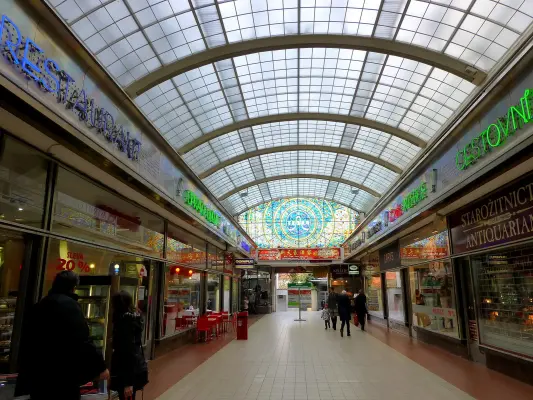
New Town offers another nighttime Prague: shop windows, cinemas, restaurants and people leaving cultural events. Combine accessible passages with dinner or a film, but remember that they may close early. Check the arrangements for the particular building.
This option suits a cooler evening or a return visit. It needs no grand finale on a hill. Looking at the city can end at a table from which you watch people passing by.
Is an evening walk suitable for children?
Match both the hour and the tone of the stories to your children. Winter darkness comes early enough to enjoy an evening atmosphere without a late return. In summer, the same effect requires a later start, which will not suit every child.
Before booking, ask whether the walk focuses on legends, history or stronger scares. For a sensitive child, puzzles and noticing details may work better than accounts of executions. Eat beforehand too: a hungry group loses interest even in a good story.
For a specific route from the centre towards the river, read Prague in the evening: what to see. Use this article to choose the character of your evening and that one to decide where to walk.
How to Combine Nighttime Sightseeing with Daytime?
The best solution is to start your stay with a route that organizes the city’s history and topography. "Prague in a Nutshell" provides a solid foundation for further exploration of Prague, while a nighttime stroll naturally deepens this knowledge, revealing the city from the perspective of emotions and legends.
If you have only one evening, consider a guided walk. After dark, it is easier to lose your bearings in the lanes; a coherent story helps turn them into a map.
Practical tips for an evening walk
- Start half an hour before dusk to see the transition from day to night.
- Dress more warmly than you expect to need: the river can be windy and the paving cools your feet.
- Wear comfortable shoes: paving stones can be slippery after dark.
- Keep your phone and wallet secure in crowds, especially around groups that stop suddenly. See the practical Prague guide.
- Book dinner after your walk if you prefer not to search for a table after 9 pm. See ten Czech restaurants for ideas.
Frequently asked questions about Prague at night
Is Prague safe at night?
Choose convenient, well-lit routes, keep your belongings secure in crowds and plan your return before heading out. Keep valuables in front of you and stay on well-lit streets.
When should an evening walk start?
Around half an hour before dusk is a useful starting point. In summer, that means a late departure; in winter, darkness arrives in the afternoon.
How do you get to and from the centre after dark?
Check the last metro service for your particular station and departure time. A later return may require night transport. Read Prague public transport in 2026.
For the Polish-speaking guide's current evening group and private options, see the tour offer or contact the organiser.