giggel / Wikimedia Commons, CC BY 3.0 · CC BY 3.0
Most visitors navigate Prague along its main streets: the square, Charles Bridge, the castle. Yet everyday city life has always unfolded in its passageways, gateways and arcades. They connected one house to another, one street to another and one era to the next.
Passages were places for daily encounters, trade and anonymity. They sheltered people from the rain, shortened journeys and allowed the city to function beyond its official story. You enter a dark gateway, take a few steps and suddenly emerge on another street, as though you had walked behind a theatre set. It is one of Prague's small pleasures.
Why are passages a key to understanding Prague?
They show the city on a human scale: without grandeur or ceremony, but with the rhythm of everyday life. As New Town developed in the early twentieth century, entrepreneurs connected buildings through internal passages containing cafés, cinemas, shops and theatres. The result survives today, and some passages still serve their original purpose. Here you can see Prague changing from Art Nouveau through modernism and Art Deco to postwar pragmatism.
The Hidden Prague: passages, architecture and city stories tour explores places that are often overlooked, although they can reveal more about the city than its main squares. The walk changes how you move around Prague afterwards: you start noticing openings where you previously saw walls.
Which passages should you know?
- Lucerna Passage: a modernist landmark with a surreal twist. David Černý's famous upside-down horse hangs here, with Saint Wenceslas sitting on its belly. Read more in Lucerna Palace: passage, cinema and Černý's horse.
- Světozor Passage: traces of cinema, poster art and everyday life after the war.
- Rokoko Passage: Lucerna's neighbour and another urban interior hidden behind a façade.
- Adria Passage: an example of Rondocubism, the Czech national style; see Adria Palace and Rondocubism.
- Unexpected passageways and hidden galleries: check access on the spot rather than assuming that every gateway leads to the next street.
Černý's horse is among the centre's most photographed sculptures. For more about its creator, read David Černý in Prague.
Passages in any weather
Passages have another advantage: a roof. On a rainy or freezing day, they offer a natural route for continuing your sightseeing with a café stop or an exhibition. Shop windows reflect the lamps, coffee steams and the rain beyond the glass becomes less of a nuisance. Find further ideas in Prague in the rain: ten places to visit.
Lucerna: look beyond the upside-down horse
Lucerna shows particularly well that a passage can be more than a shortcut. People come for the cinema, a café, a meeting or an event; visitors stop beneath the sculpture and briefly join the same flow of city life. Look at the ceiling, the arrangement of the passageways, the shopfronts and the relationship between an impressive public interior and the building's everyday uses.
Pause at Černý's horse to make a comparison. In Wenceslas Square, the patron saint sits on his horse in a monumental statue. In the passage, you find its mischievous reflection. The horse is upside down; Wenceslas sits on its belly. That distinction matters to the joke. Prague City Tourism describes the work and its location.
There is no need to reduce the sculpture to one correct interpretation. Consider what happens to a monument's solemnity when it moves beneath the roof of a shopping passage. It opens a conversation about Czech humour, public art and the ways contemporary Prague comments on its own symbols.
Světozor and Rokoko: a city walk on a smaller scale
In Světozor, notice how the passage relates to the cinema and small shops. Take your time: a programme, poster display or shop window can reveal as much about the contemporary city as an account of its designers. Check which exit is actually accessible before moving on.
Combine Rokoko with Lucerna to compare neighbouring urban interiors. Rather than ticking off names, choose one detail in each: a lamp, a railing, lettering or the way the passage is lit. The walk then becomes an exploration of architecture rather than a journey from A to B with a phone held in front of your face.
An open gateway is not necessarily a public passage. Do not enter staircases or courtyards marked private. Access may depend on the building's opening hours, so have an ordinary street route in mind as well.
Adria: start with the façade
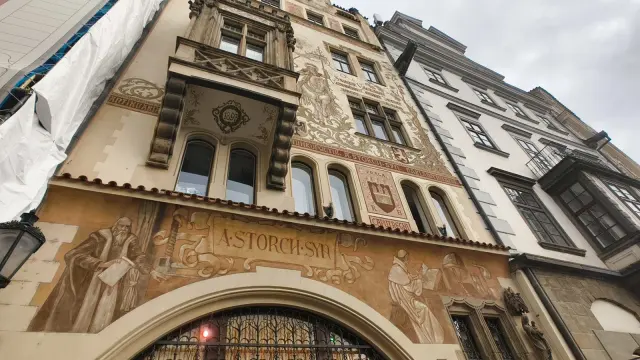
Begin outside Adria. Its elaborate façade shows that Prague's twentieth-century architecture extends beyond simple modernist forms. Then look into the accessible interior and compare the monumental corner with the space intended for pedestrians.
For context, read Adria Palace and Rondocubism. On a route through several passages, this is a good place to shift the conversation from cinemas and cafés to style, representation and the modern centre of a capital city.
A ready-made route: New Town's passages at an unhurried pace
Allow around two to three hours for an independent walk with a break. This is a rough suggestion, depending on building access and the length of your café stop.
- Start in Wenceslas Square and look at its buildings before heading indoors.
- Visit Rokoko and Lucerna, spending longer in one interior of your choice.
- Continue towards Vodičkova and Světozor. Check the available exits instead of assuming that one shortcut is always open.
- Stop for coffee or lunch. Passages are places to rest as well.
- Head towards Národní and Adria Palace. Finish by comparing its façade with those around Wenceslas Square.
This route is not one continuous heated corridor. You go outdoors between passages, so you still need a jacket in the rain. Some passages may be cold in winter, while shade in summer does not necessarily mean air conditioning.
Who will enjoy this walk most?
It suits a return visit to Prague, anyone interested in architecture and travellers who prefer everyday city spaces to major monument complexes. On a first visit, you can add the passages after exploring Old Town, without squeezing them between the castle and Vyšehrad.
Families can look for unusual sculptures or old signs. If you need to avoid stairs, choose the precise route carefully: New Town is easier than the steep hills, but thresholds and access to exits vary. Mention these needs to the organiser of a private walk.
How to explore the passages
- Leave room for discovery. Give yourself time to look into side passages where access is permitted.
- Notice the details: tiles, lamps, signs and staircases.
- Visit cafés and cinemas: some have been operating for decades.
- Choose quieter times. Mornings and late afternoons can be calmer.
A walk that changes how you move through Prague
To explore the passages alongside stories about their creators and history, see Hidden Prague: passages, architecture and city stories. Check the current meeting point in the tour description. It is a natural next step after Prague in a Nutshell if you already know Old Town.
Frequently asked questions about Prague's passages
Is there an entrance fee?
Walking through is usually free; cinemas, theatres and museums inside charge for their own activities.
Where is David Černý's horse?
In Lucerna Passage, near Wenceslas Square.
Is a passage walk suitable for seniors?
You can choose a route with fewer climbs, but discuss thresholds, stairs and access beforehand. You go outdoors between passages.
For the Polish-speaking guide's current group and private options, see the tour offer or contact the organiser.